
Journal of Environmental Treatment Techniques 2015, Volume 4, Issue 4, Pages: 173-175
173
Green Highway Development Features to Control Stormwater
Runoff Pollution
Muhd Zaimi Abd Majid
1
, Yao Bigah
1
, Ali Keyvanfar
1,*
, Arezou Shafaghat
1
, Jahangir Mirza
1
, Hesam Kamyab
2
1- Construction Research Center (CRC), Institute for Smart Infrastructure and Innovative Construction (ISIIC), Department of
Structures and Materials, Faculty of Civil Engineering, Universiti Teknologi Malaysia, Skudai, Johor, 81310, Malaysia.
2-
Institute of Environmental and Water Resource Management (IPASA), Faculty of Civil Engineering, Universiti
Teknologi Malaysia, Johor, 81310, Malaysia.
Received: 11/010/2015 Accepted: 28/11/2015 Published: 30/12/2015
Extended Abstract
1
Beside buildings, highways and roads construction
interfere with Stormwater runoff (SWR). They have two
main impacts. They generate more runoff and pollutants
while they contribute to the increase in impervious surfaces
in the watershed and intensify activities. Regarding the
increase of impervious surfaces, United States
Environmental Protection Agency [1] states that roads
occupy one third to two third of the land portion of the city
(mostly impervious surfaces).
The resulting effects of the hydro modification are
increased volume of the runoff, change in sediment
loading. From undeveloped area to developed zone with 30
to 50% of road impervious surface, the storm runoff rate
increases from an average of 10% to 30% of the rain fall
[2]. Kansas Department of Health and Environment
exhaustively listed water pollution indicators as ammonia,
total suspended solids (TSS), biochemical oxygen demand
(BOD) and chemical oxygen demand (COD), chlorophyll,
dissolved solids, heavy metals, minerals, nitrates,
pesticides, pH, phosphorus, temperature, and turbidity.
Barrett et al. [3] state highway pollutants are from three
categories: organic, inorganic and microbial pollutants.
Inorganic Pollutants (most common heavy metals) and the
group of nutrients (herbicides, pesticides)) are toxic in high
concentration and tend to amass into the tissue of aquatic
flora and fauna [4,5]. Coliform bacteria are ordinary
microbial pollutants encountered in storm runoff. They are
of meticulous interest due to their easy access into the
runoff either through anthropogenic sources or illicit
connections to stormwater sewer system. Waterborne
diseases originating from non-point sources (NPS)
pollution are alleged to be more detrimental than
sedimentation issues in developing countries [6].
Additionally, erosion and sedimentation process contribute
to Stormwater runoff pollution. Sediment sources from
Corresponding author: Ali Keyvanfar, Construction
Research Center (CRC), Institute for Smart
Infrastructure and Innovative Construction (ISIIC),
Department of Structures and Materials, Faculty of Civil
Engineering, Universiti Teknologi Malaysia, Skudai, Johor,
81310, Malaysia.
roadways include road sanding, runoff from unpaved roads
and areas where soil has been exposed during construction.
Malaysia is a country with an objective of being a fully
developed country by 2020. Among the objectives stated in
Malaysian’s 10th Master Plan (2010-2020) increasing
water resources pollution and providing quality water
which is expected to grow over 70% of the total population
[7]. Controlling water pollution, water resource
management is a priority in Malaysia where more than 90%
of water supply if from rivers and lakes [8]. As a matter of
fact, highway/roads have been identified, and developed
countries are moving forward in curbing highway-related
water pollution through the establishment of highway
assessment framework. The current study aimed to identify
criteria and sub-criteria in Green Highway development
towards controlling Stormwater runoff pollution in
Malaysia.
A questionnaire form was designed for data collection.
The scaling range was 1: strongly disagree, to 5: strongly
agree, to obtain the agreement level of respondents from 22
companies and 109 consultants in highway engineering.
The research has applied the Average Index method (was
developed by Abd Majid and McCaffer [9]) which provides
means to ascertain respondents validation of a criterion.
The Average or the Mean Index of a criterion is evaluated
using the following Equation:
Average/Mean Index =
∑
a
i
X
i
∑
X
i
Where, a = constant, weighing factor for i, {i = 1, 2,
3.........n}; Xi = frequency of respondent. According to
result analysis presented in Table 1, the most significant
sub-criteria are Confirm wastewater treatment with the
local authority, and Equip to control and monitor pollutant
loads of stormwater and wastewater runoff to comply with
regulatory requirements that scored the same average of
3.833. Applying the LID best management practices of
sand filters, dry/wet swales, and bio retention, and other
structural BMPs to treat 90 percentile of annual rain fall,
provide and preserve existing buffer zones, determine and
reduce pollutant loads to maintain water resources using
Best Management Practices followed the most significant
criteria while scoring respectively 3.77, 3.73 and 3.71. The
lowest score, 3.58 is taken by the less significant criteria
Journal weblink: http://www.jett.dormaj.com
J. Environ. Treat. Tech.
ISSN: 2309-1185
Journal of Environmental Treatment Techniques 2015, Volume 4, Issue 4, Pages: 173-175
174
namely in contrast, prepare control practices of sediments
and erosion to shield soils, and protect the construction and
demolition materials throwing to waterways have been
scored as the lowest average index amongst other sub-
criteria.
Table 1: Average Index Analysis of SWRQ Sub-criteria
No.
Sub-criteria description
N
Mean
Std.
Deviation
Minimum
Maximum
Score
Valid
Missing
1
Explore and remove non-stormwater released from non-
hygienic sources or other commercial residential, or
industrial sectors
140
0
3.69
.662
3
5
3.69
2
Explore non-stormwater released from non-hygienic sources
or other commercial residential, or industrial sectors
140
0
3.60
.763
1
5
3.60
3
Confirm wastewater treatment with the local authority
140
0
3.83
.684
3
5
3.83
4
Determine and reduce pollutant loads to maintain water
resources using Best Management Practices
140
0
3.71
.640
2
5
3.71
5
Equip to control and monitor pollutant loads of stormwater
and wastewater runoff
140
0
3.83
.755
2
5
3.83
6
Applying the LID best management practices of sand filters,
dry/wet swales, and bio retention
140
0
3.77
.710
2
5
3.77
7
Prepare control practices of sediments and erosion to shield
soils
140
0
3.58
.670
2
5
3.58
8
Protect the construction and demolition materials throwing
to waterways
140
0
3.58
.709
2
5
3.58
9
Restore wetlands and reduce cut and fill areas
140
0
3.65
.714
2
5
3.65
10
Provide and preserve buffer zone (Jabatan Perhutanan &
Perhilitan, DOE)
140
0
3.73
.674
3
5
3.73
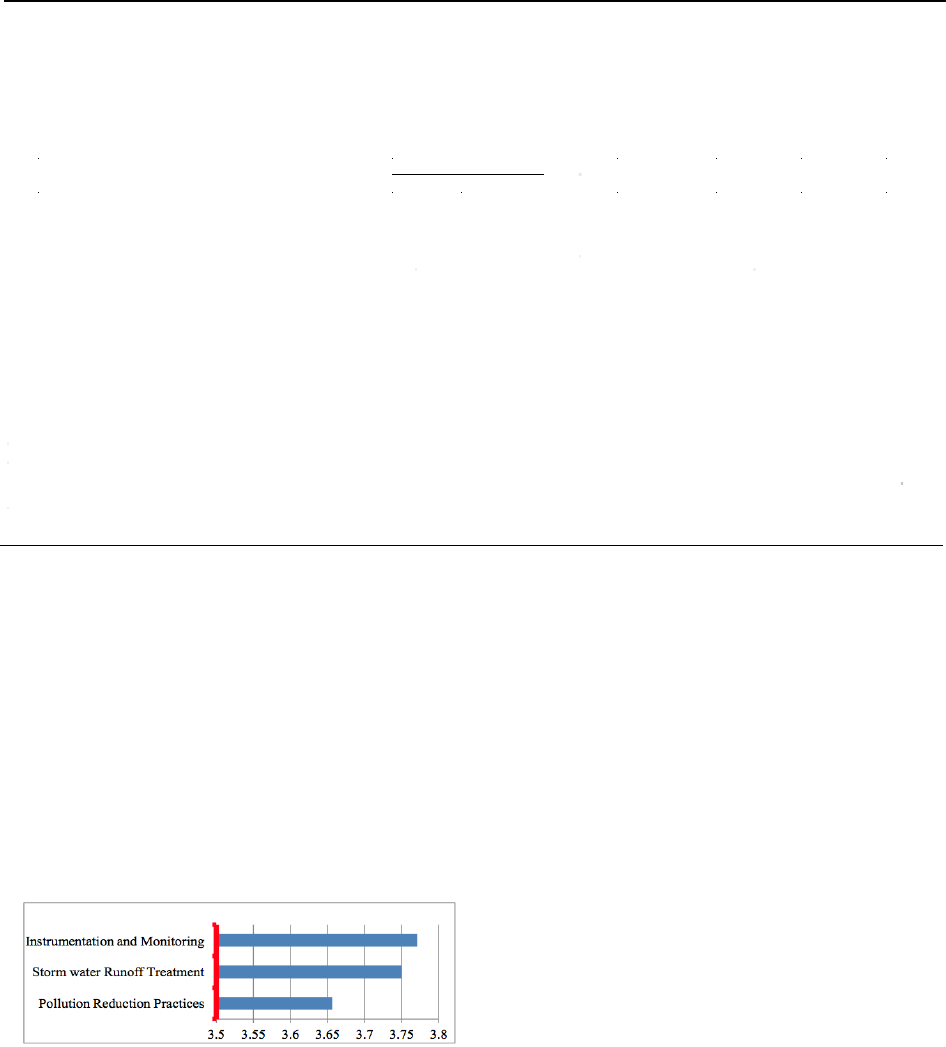
The sub-criteria are grouped into three major criteria
which are shown in Fig. 1. Instrumentation and monitoring
of highway runoff, storm runoff treatment, and pollution
reduction practices represent the three group of criteria
under which fall the sub-criteria. Those criteria score
respectively an average of 3.77, 3.75, and 3.66. Each of the
three criteria has an average index higher than 3.5, which
means that they are accepted as green highway criteria.
Furthermore, instrumentation and monitoring, and
Stormwater runoff treatment criteria are more significant as
they score an average index of the same range which is
higher than that of the pollution reduction practices
criterion. In fact, highway runoff constituents and loadings
are still under exploration. Monitoring of the SWRQ is the
only way to provide such understanding.
Fig. 1: Average Index Analysis of Stormwater Runoff Quality Control
Criteria
Consequently the study provides means to construct
highway development toward more sustainable practices.
The study identifies green highway SWRQ control criteria
and sub-criteria to achieve better control of water pollution;
i. Green highway SWRQ control criteria are
Instrumentation and Monitoring of SWRQ, Stormwater
Runoff Treatment, and Pollution Reduction Practices.
These criteria are composed of sub-criteria among which
providing and preserving existing buffer zones are the
most significant sub-criteria.
ii. Stormwater runoff pollution control criteria represent
30% in the group of water and environment protection.
Three main sub-criteria are identified: pollution
reduction practices, storm water treatment, and
instrumentation and monitoring of runoff. Each
individual criteria scored three points.
As the future study, the specific needs from water
resources of various watershed can be explored in order to
design appropriate stormwater plan for various zones.
Acknowledgements
The authors would like to thank the PAS grants vote
no. Q.J130000.2709.01K40 and Q.J130000.2709.01K41,
and GUP grants vote no. Q.J130000.2609.11J04 and
Q.J130000.2609.10J8, and MOSTI grant vote no. 4S123.
Also, the authors appreciate these organizations for their
supports and contributions, TNCPI, and Research
Management Center at Universiti Teknologi Malaysia.
References
1- US. EPA (1995) Polluted Runoff (Nonpoint Source
Pollution) Managing Urban Runoff, Planning
Considerations for Roads, Highways and Bridges EPA
841- F-96-004G. Washington, D.C.
http://www.epa.gov/cgi-bin/epaprintonly.cgi
2- Envision v2.0, (2012). A Rating System for Sustainable
Infrastructure. Institute for Sustainable Infrastructure,
University of Harvard, Washington D. C.
3- M.E. Barrett, J.M. Malina, R.J. Charbeneau, and G.H.
Ward, (1995). Characterization of Highway Runoff in
the Austin, Texas Area. Center for Research in Water
Resources, Austin, Texas.
4- R. Pitt, R. Bannerman, S. Clark, D. Williamson (1995).
Sources of Pollutants in Urban Areas (Part 2) – Recent
Sheetflow Monitoring, Birmingam, USA.
5- V. Novotny, H. Olem, (1994). Water quality. Diffuse
Pollution and Watershed Management.
6- 10th Malaysian Master Plan 2010-2020,
https://www.pmo.gov.my/dokumenattached/RMK/RM

Journal of Environmental Treatment Techniques 2015, Volume 4, Issue 4, Pages: 173-175
175
K10_Eds.pdf
7- M.P. Wanielista, Y.A. Yousef, (1993). Stormwater
management. John Wiley & Sons.
8- 10th Malaysian Master Plan 2010-2020,
https://www.pmo.gov.my/dokumenattached/RMK/RM
K10_Eds.pdf
9- M.A. Majid, R. McCaffer, R. (1997). Assessment of
Work Performance of Maintenance Contractors in
Saudi Arabia. Journal of management in
Engineering, 13(5): 91-91.