
Journal of Environmental Treatment Techniques 2015, Volume 3, Issue 4, Pages: 184-200
184
Planetary Boundaries Must not be Crossed for the Survival of
Humanity
Haradhan Kumar Mohajan
Premier University, Chittagong, Bangladesh
Received: 14/11/2015 Accepted: 11/12/2015 Published: 30/12/2015
Abstract
At present we are living in an increasingly globalized world. The scientific impact of the planetary boundary framework is
based on biological, physical and chemical structures, and also is an important item for the sustainability. During the last five
decades, global population, food production, and energy consumption have increased remarkably. For the growing population,
sustainable economic development and standard of living, including living space, food, fuel, and other materials by sustaining
ecosystem services and biodiversity are necessary. This article tries to identify the sustainable development policy on the basis of
planetary boundaries. This planet has limited natural resources but human beings are using these in unplanned and competitive
ways. Since 2008 scientists have been identified nine planetary boundary processes. These provide a safe space for innovation,
growth and development in the detection of human prosperity. Out of these nine boundaries four have already been passed due to
human activities and two boundaries still need to be determined. If these nine boundaries passed due to unconsciousness and
unplanned activities of humankind, then the living organisms of the earth will face threat for the survival. The paper analyzes
sufficient theoretical analysis to make it interesting to the readers. The study stresses on sustainable development policy for the
welfare of humanities. The results of the study are presented by chemical reactions and sufficient numerical scientific data. An
attempt has been taken here to create consciousness among the nations of the world about the effects of the crossing of the
planetary boundaries.
Keywords: Biodiversity, Environmental Sustainability, Greenhouse Gas Emissions, Nitrogen and Phosphorus Cycle, Planetary
Boundaries.
1 Introduction
1
At the end of the 20
th
and at the beginning of the 21
st
century the concept of planetary boundaries (PBs) become
a pioneer issue to the environment experts. These are
common and essential items for all nations of the world. PB
concept rests on three branches of scientific inquiry are as
follows:
1. Earth system and sustainability science.
2. Scale of human action in relation to the capacity
of the planet to sustain it.
3. Shocks and abrupt change in social-ecological
systems from local to global scales.
Different aspects of the environment, such as, biological
(biotic), physical (abiotic), social, cultural, and
technological factors affect the health status of human
population as well as other species within the ecosystems
[1]
During the past five decades, global population, food
production, and energy consumption have increased
approximately 2.5-fold, 3-fold and 5-fold, respectively [38,
48]. As the global human population is growing faster, the
additional land will be needed for living space and
Corresponding author: Haradhan Kumar Mohajan,
Premier University, Chittagong, Bangladesh, Email:
haradhan_km@yahoo.com.
agricultural production. An important issue is how to meet
growing human demands for living space, food, fuel, and
other materials by sustaining ecosystem services and
biodiversity [80].
Global increase of fertilizer use, fossil fuel consumption
and the cultivation of leguminous crops, have been doubled
the rate at which biologically available nitrogen (N
2
) enters
the terrestrial biosphere compared to preindustrial levels
[45].
Industrial and anthropogenic activities have increased
air pollution that cause serious global environmental
problem. As a result agricultural production and water
supply has reduced, human health deteriorated, ozone
depletion created serious problem in the atmosphere.
2 Literature Review
In 2009, a group of 29 internationally renowned
scientists led by Johan Rockström and Will Steffen have
identified and quantified a set of nine PBs [103]. The
Intergovernmental Panel on Climate Change (IPCC) and N.
Stern expressed that global warming is due to continuous
increase of GHG emissions which causes global climate
change [56, 119]. The Economics of Ecosystems and
Biodiversity (TEEB) indicated that at present more than
100 species out of a million are going extinct each year.
The proposed boundary is set at 10 species per million
species per year [122]. Rockström and his co-authors
Journal web link: http://www.jett.dormaj.com/
J. Environ. Treat. Tech.
ISSN: 2309-1185

Journal of Environmental Treatment Techniques 2015, Volume 3, Issue 4, Pages: 184-200
185
studied that the cycles of Nitrogen (N
2
) and Phosphorus (P)
are essential for plant growth on the earth [105]. R. J. Diaz
and R. Rosenberg indicated that excess N
2
and P are liable
to negative human health and environmental impacts such
as, groundwater pollution and loss of habitat and
biodiversity [26]. A. Webb studied that the ozone layer is
natural filter and protective shield that surrounds the earth
to protect human, animal fish and plants from the harmful
ultra violet (UV–B) radiations [138]. M. Molina and F.S.
Rowland confirmed that human produced chemicals could
destroy O
3
and deplete the ozone layer [85]. WHO and
UNICEF estimated that about 4,500 children die in a day
for the lack of drinking water supply and sanitation
facilities. About 1.8 million people die every year from
diarrhoeal diseases [141]. B. Rimal indicated that land use
change effects on global environmental change and
landscape ascription [101]. IPCC demonstrated that
ambient aerosol particles are responsible for adverse health
effects, creation of haze pollution both in urban and in the
rural area, visibility reduction on human and influence on
climate [56]. J. C. Orr and his co-authors revealed that
ocean acidification effects on food webs, fisheries
(shellfish), marine ecosystems (corals, coralline algae,
mollusks and some plankton), coastal erosion and tourism
[91]. The US Environmental Protection Agency (EPA)
estimated that there are 80,000 to 100,000 chemicals on the
global market [131]. B. Lomborg stated that hundreds of
tons of hazardous waste are released to the air, water, and
land by industry every hour of every day and the chemical
industry is the biggest source of such waste [71].
3 Methodology of the Study
The article is prepared on the basis of secondary data of
previous published articles, books and various research
reports of the scientists. In this study we have contributed
the knowledge and experience of the present human
activities that making the earth to the unsafe place for the
living organisms in future. The concept of the planetary
boundary comes in the beginning of the 21
st
century. Due to
population growth there is an enormous change in global
economy. At the same time with competitive economy the
industrialized countries emit greenhouse gases which cause
global climate change. Ocean acidification, stratospheric
ozone depletion, atmospheric aerosol loading, excess use of
nitrogen and phosphorus, and chemical pollution has
created serious problems for the safe survival of the
humankind and other creatures. Land is one of the most
important natural resources and used for residential,
commercial and agricultural purposes. But human beings
are overusing the lands for their needs which are threat for
the future generations. Water is an essential element for all
living organisms. But the use and abuse of water has
increased widespread water scarcity, water quality
deterioration, and the destruction of freshwater resources.
We need to think and act accordingly to make the earth safe
and nice living place for the future generation. In 2009, a
group of 29 internationally renowned scientists led by
Johan Rockström and Will Steffen identified and quantified
a set of nine PBs for the so-called ‘safe space for
humanity’. In this study we have worked on the nine PBs to
send message to all nations for the consciousness of these
PBs.
4 Aims and Objective of the Study
The aim and objective of this study is to identify
sustainable development policy on the basis of planetary
boundaries. The scientists have been identified nine
planetary boundaries. Beyond of these boundaries
anthropogenic change will put the earth system outside a
safe operating space for humanity. The 21
st
century faces
critical social and economic problems and we have to work
together for the survival of the humanity by solving these
problems efficiently. We hope the readers will be benefited
and will be realized the importance of the planetary
boundary for the sustainable development at present and in
future.
5 Brief Histories of Planetary Boundaries
In 2008, an interdisciplinary group of scientists started
the discussions about planetary boundaries (PBs) in a
workshop convened by the Stockholm Resilience Centre,
the Stockholm Environment Institute and the Tällberg
Foundation. In 2009, a group of 29 internationally
renowned scientists (led by Johan Rockström from the
Stockholm Resilience Centre and Will Steffen from the
Australian National University) identified and quantified a
set of nine PBs within which humanity can continue to
develop and thrive for generations to come, the so-called
‘safe space for humanity’. After 2009, the concept of PBs
has gained strong interest not only throughout the scientific
community but also within the world of policy-making and
civil society [94, 103].
The PBs provides a safe space for innovation, growth
and development in the pursuit of human prosperity. Within
this safe operating space, low likelihood of harming the
earth’s life support systems, such that they are able to
continue to support growth and human development [102].
Earlier approaches of PB were [42]: i) human actions as
embedded in earth’s life-support system [89], ii) a human-
dominated planet [134], and iii) work in ecological
economics on global biophysical constraints for the
expansion of the economic subsystem [17, 22, 23].
Johan Rockström and his co-authors in a Nature Feature
argued that “To avoid catastrophic environmental change
humanity must stay within defined planetary boundary for a
range of essential Earth-system processes. If one boundary
is transgressed, then safe levels for other processes would
risk triggering abrupt or irreversible environmental
changes.” For example, converting the Amazon rainforest
to a grassland or savanna could influence atmospheric
circulation globally and ultimately affect water resources in
Eastern Asia through changes in rainfall [103].
The concept of PBs has recently been introduced
towards the earth system, through which it becomes
possible to define the biological, physical and chemical
structures that enable the development of complex human
societies in the last 10,000 years (the Holocene period
during which we developed agriculture, villages, cities and
contemporary civilizations) to define a ‘Safe Operating
Space for Humanity’ [24]. Human societies developed

Journal of Environmental Treatment Techniques 2015, Volume 3, Issue 4, Pages: 184-200
186
since Holocene period from small groups of hunter-
gatherers through larger agricultural communities to global
urban-industrial society in the 21
st
century [60]. The
Anthropocene (anthropo for man and cene for new) started
around the beginning of 1800 with the Industrial
Revolution in England and concluded its first stage after
World War II in 1945. In the Anthropocene, human is
accelerating departure from the stable environmental
conditions of the past 12,000 years into a new, unknown
state of the earth. This period has been characterized
mainly by an enormous expansion in the use of fossil fuels,
first coal and then oil and gas. The 2
nd
stage of
Anthropocene started in 1945 and is coming to an end in
these very years [21, 116]. The PBs are values for control
variables that are either at a ‘safe’ distance from thresholds,
for processes with evidence of threshold behavior or at
dangerous levels for processes without evidence of
thresholds [103].
The precedent era the ‘Holocene’ has permitted human
civilizations to thrive, especially because it guaranteed a
stable warm period (for 10,000 years ca.) without dramatic
variations, which is not usual in the history of humans’
appearance on the earth [117].
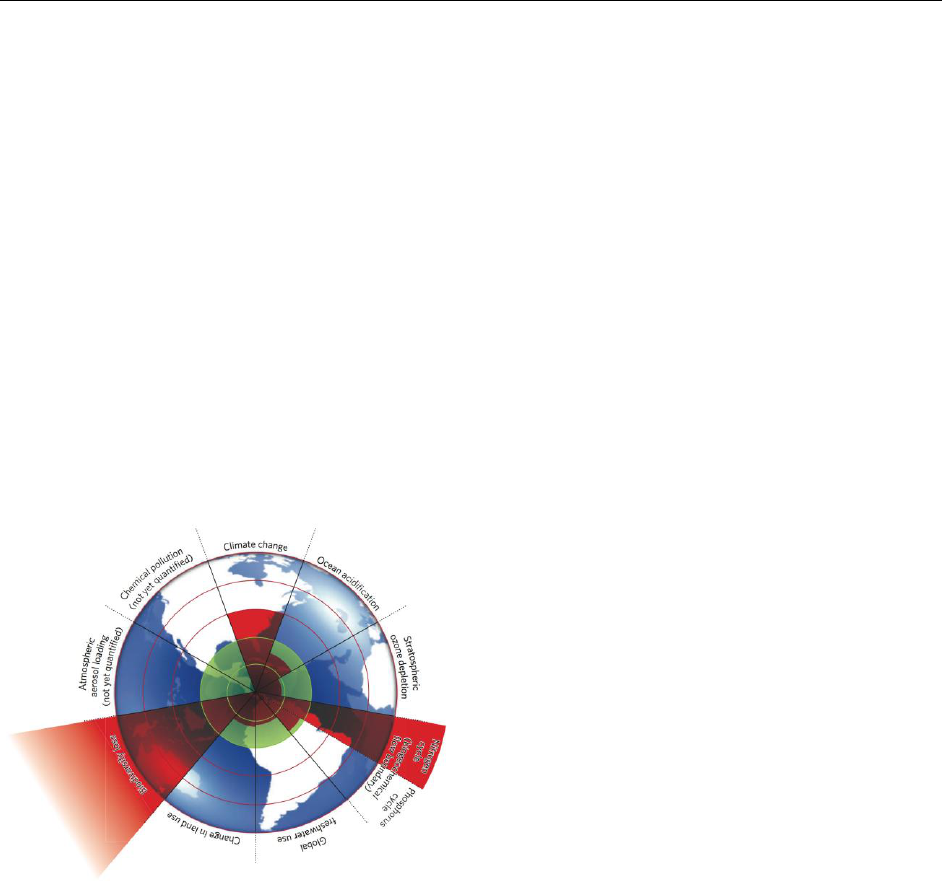
Nine planetary boundary (PB) processes have been
identified, which are as follows (figure 1): Climate change,
stratospheric ozone depletion, ocean acidification, land use
change, freshwater use, rate of biodiversity loss,
interference with global nitrogen and phosphorus cycles,
aerosol loading and chemical pollution have been identified
[102]. A clear strength of the nine PB frameworks is that it
offers a comprehensive and possibly exhaustive set of non-
weighted variables to capture key global environmental
challenges rather than existing single-issue indicators and
footprint tools, for example, the carbon footprint as an
indicator of national environmental performance. Seven of
these nine were possible to quantify at present by
identifying control variables (e.g., for climate change,
atmospheric CO
2
concentration) and setting specific
boundary values (e.g., 350 ppm CO
2
) [88]. These nine
boundaries are expected to lead to an increased risk to one
or more aspects of human wellbeing, or would undermine
the resilience of the earth system as a whole [102]. Beyond
of these boundaries anthropogenic change will put the earth
system outside a safe operating space for humanity [73].
The identification of the nine Bs was not based on available
data and two have not yet been quantified (table 1).
Table 1: The nine planetary boundaries [103].
Earth system process
Control variables
Proposed
boundary
Most recent
measurement
Climate change
1. Atmospheric CO
2
concentration (parts per million).
2. Change in radioactive forcing (W/m
2
).
350 ppm
+1 W/m
2
393.81 ppm
+1.87 W/m
2
Ocean acidification
Global mean saturation state of aragonite in surface sea water.
2.75
2.90
Stratospheric ozone
Depletion
Concentration of ozone (Dobson units).
276 DU
283 DU
Biogeochemical
flows: nitrogen cycle
and phosphorus
cycle
1. Amount of N
2
removed from the atmosphere for human use
(millions of tons per year).
2. Quantity of P flowing into the oceans (millions of tons per
year).
35 Mt
11 Mt
121 Mt
8.5–9.5 Mt
Atmospheric aerosol
loading
Overall particulate concentration in the atmosphere, on a
regional basis.
To be
determined
To be
determined
Fresh water use
Consumption of fresh water by humans (km
3
per year).
4,000 km
3
2,600 km
3
Land use change
Percentage of global land cover converted to cropland.
15%
11.7%
Rate of biodiversity
loss
Extinction rate (number of species per million species per
year).
10 E/MSY
>100 E/MSY
Chemical pollution
For example, amount emitted to, or concentration of persistent
organic pollutants, plastics, endocrine disrupters, heavy metals
and nuclear waste in the global environment, or the effect on
ecosystem and functioning thereof.
To be
determined
To be
determined
The red areas show the position of each boundary. The
safe operating spaces for the boundaries are within the
green area (Figure 1). Out of these nine boundaries four
have already been passed due to human activities: Climate
change, loss of biosphere integrity, land-system change,
altered biogeochemical cycles (phosphorus and nitrogen),
whilst two boundaries still need to be determined
(atmospheric aerosol loading and chemical pollution). Two
of these, climate change and biosphere integrity, the
scientists call ‘core boundaries’ [118]. It is estimated that
within a very short time world will face the difficulties of
shortage of freshwater, change in land use, ocean
acidification and interference with the global phosphorous
cycle [102].
The PBs are not fixed and they represent estimates of
how close to an uncertainty zone that the global human
community can act, without seriously challenging the
continuation of the current state of the planet [43].
6.1 Climate Change
Global warming is due to continuous increase of GHG
emissions. The current concentrations of GHG in space
have increased since the industrial revolution (in 1750)
from a CO
2
equivalent of 280 parts per million (ppm) to
Journal of Environmental Treatment Techniques 2015, Volume 3, Issue 4, Pages: 184-200
187
450 ppm [84, 119]. The global surface temperature has
increased ≈ 0.2
0
C per decade in the last three decades.
Global warming is now +0.6
0
C in the past three decades
and +0.8
0
C in the past century, and continued warming in
the first half of the 21
st
century is consistent with the recent
rate of +0.2
0
C per decade [50, 81]. The atmospheric
concentrations of CO
2
grew 80% from 1970 to 2004, and
recently exceed by far the natural range over the last
650,000 years [56].
Scientific research shows that ice loss from Antarctica
and Greenland has accelerated over the last 20 years which
will raise the sea level. From satellite data and climate
models, scientists calculated that the two polar ice sheets
are losing enough ice to raise sea levels by 1.3 mm each
year and scientists observed that the sea levels are rising by
about 3 mm per year. By 2006, the Greenland and Antarctic
sheets were losing a combined mass of 475 Gt of ice per
year. If these increases continue water from the two polar
ice sheets could have added 15 cm to the average global sea
level by 2050. A rise of similar size is expected to come
from a combination of melt water from mountain glaciers
and thermal expansion of sea water [9].
Figure 1: Planetary Boundaries [102]
Climate boundary is based on two critical thresholds
parameters: Atmospheric concentration of CO
2
and
radiative forcing [56]. The PB for climate change was
proposed the CO
2
level as a maximum 350 ppm (table 1)
and in 2014 it is crossed 400 ppm. The radiative forcing
should not exceed 1 Wm
–2
above pre-industrial levels but
the change in radiative forcing is 1.8 Wm
–2
[105, 107].
In the 21
st
century carbon budget of 1,456 GtCO
2
would
result in a lower than 2°C warming at 450 CO
2
eq. At the
time of this analysis in 2007, this global carbon budget
would correspond to annual emissions of 14.5 GtCO
2
/y,
and per capita emissions of no more than 2 tons CO
2
/y [77,
126].
More recent analysis expresses that 2
0
C target requires
21 GtCO
2
eq/y in 2050, and assuming that 76% of these are
CO
2
emissions give a budget of 16 GtCO
2
/y [129]. It is true
that about 50% of global CO
2
emissions produced by 11%
of people.
6.2 Rate of Biodiversity Loss
Biodiversity is the natural capital we depend on to
sustain ecosystem functions, which is another PB of major
concern that has been passed. Before industrialization the
extinction rate was less than one species per million species
each year. At present more than 100 species out of a
million are going extinct each year. The proposed boundary
is set at 10 species per million species per year [122]. In the
last 20 years, about half of the recorded extinctions are
primarily due to land-use change, species introductions, and
increasingly climate change [94]. Biodiversity is not only
about species numbers but also concerns variability in
terms of habitats, ecosystems, and biomes [90].
Biodiversity is one of the four “slow” boundaries,
which seem to be associated with local-to-regional scale
thresholds rather than global ones [104]. Biodiversity loss
is considered as the single boundary where current rates of
extinction put the earth system furthest outside the safe
operating space. It is a slow process without known global-
level thresholds, that there is incomplete knowledge on the
role of biodiversity for ecosystem functioning across scales,
and that the suggested boundary position was therefore
highly uncertain [73]. Loss of biodiversity is now called
‘Change in biosphere integrity’.
Conversion of forest to cropland, increased use of
nitrogen and phosphorus fertilizers, and increased
extraction of freshwater for irrigation could all act together
to reduce biodiversity more than if each of these variables
acted independently [102].
If the corals are degraded due to temperature rise, as a
consequence of climate change, not only the corals
disappear but also the fish species associated with them
[46].
6.3 Nitrogen and Phosphorus Cycle
Nitrogen (N
2
) and Phosphorus (P) move among the
atmosphere, soil, water, and organisms in a process called
the nitrogen (figure 2) and phosphorus cycle, respectively.
Both are biogeochemical cycles and are very important for
ecosystems. This transformation can be carried out through
both biological and physical processes [144]. The cycles of
N
2
and P are essential for plant growth on the earth. The
availability of N
2
and P in the biosphere has increased
massively over the last decades [105]. The production of
industrial fertilizer and the cultivation of leguminous crops
are major causes to increase of large scale N
2
and P. Since
the increased production of N
2
fertilizers through the
Haber–Bosch process and increased mining of phosphate
rock, the consumption of inorganic fertilizers in agriculture
has increased exponentially. Between 1950 and 1994, there
was a sustained increase in global annual consumption of
N
2
and P fertilizers from 3 to 74 million tons N
2
and from
2.4 to 13 million tons P [74].
The increased use of N
2
and P fertilizers has allowed for
producing the food necessary to support the rapidly
growing human population [44]. On the other hand
mobilized N
2
and P in watersheds enter groundwater and
surface water and are transported through freshwater to
coastal marine systems has resulted negative human health
and environmental impacts such as, groundwater pollution,
Journal of Environmental Treatment Techniques 2015, Volume 3, Issue 4, Pages: 184-200
188
loss of habitat and biodiversity, an increase in frequency
and severity of harmful algal blooms, eutrophication,
hypoxia and fish kills [26, 98, 124].
6.3.1 Nitrogen Cycle
Nitrogen gas (N
2
) comprises 79% of the earth’s
atmosphere. There are about 5 billion metric tons of N
2
contained in the atmosphere, ocean, terrestrial and marine
biota, soil organic matter and sedimentary rocks, and less
than 2% is available to organisms. N
2
is present in the
environment in a wide variety of chemical forms like,
organic N
2
, ammonium (NH
4
+
), nitrite (NO
2
−
), nitrate
(NO
3
−
), nitrous oxide (N
2
O), nitric oxide (NO) or inorganic
nitrogen gas (N
2
). Nitrogen is plentiful in the atmosphere,
but limited in soils because of the strength of the triple
bond that holds the two nitrogen atoms together and often
constrains plant growth. To increase food production
farmers use N
2
fertilizer. N
2
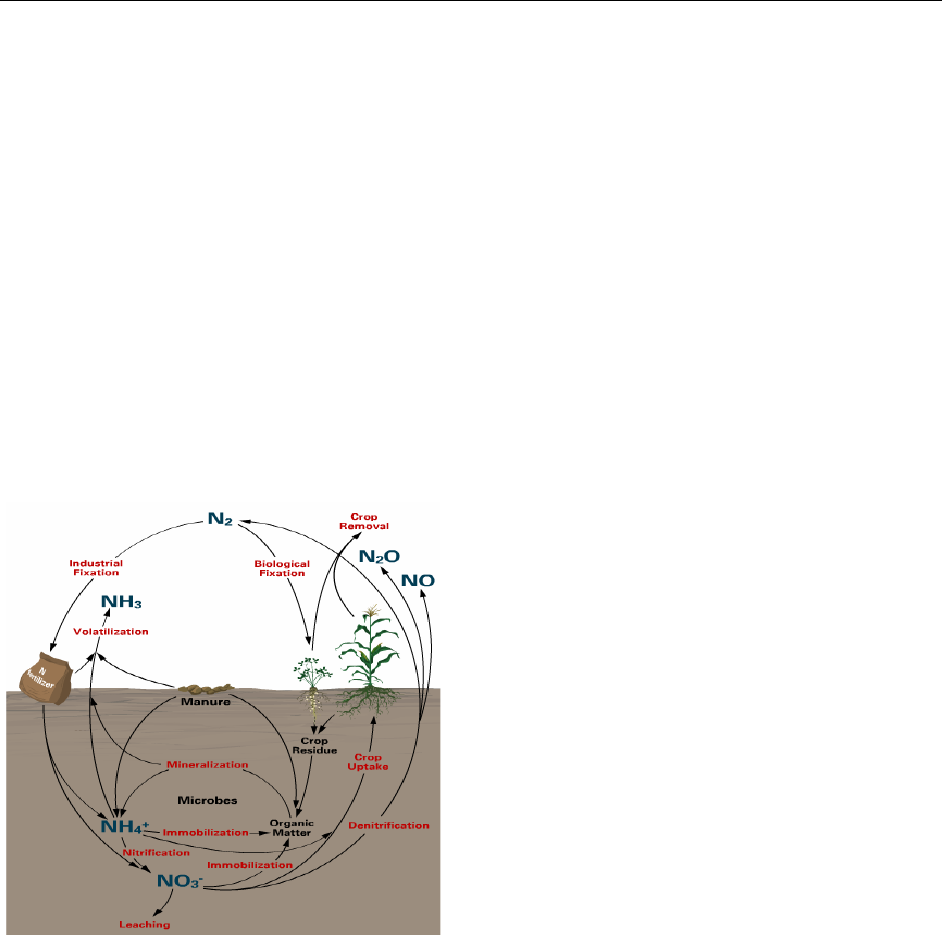
cycle consists of following
processes: i) nitrogen fixation, ii) mineralization, iii)
nitrification, iv) immobilization, v) denitrification, vi)
volatilization, and vii) leaching [13].
Figure 2: Nitrogen Cycle [61]
Simple interpretations of these 7 items are as follows [61]:
Fixation: Fixation is the conversion of atmospheric N
2
to a
plant available form. This process is happen during the
production of commercial fertilizers or during a biological
process (legumes such as alfalfa, soybeans and clovers
convert atmospheric N
2
with specific bacteria, to a form
plants can use). For this process requires energy, enzymes
and minerals;
N
2
→NH
3
→R–NH
2
where ‘R’ indicates hydrocarbon ion.
Mineralization: Mineralization is the process by which
microbes decompose organic N
2
from manure, organic
matter and crop residues to ammonium;
R–NH
2
→NH
3
→NH
4
+
.
Nitrification: Nitrification is the process by which
microorganisms convert ammonium to nitrate to obtain
energy;
NH
4
+
→NO
2
–
→ NO
3
–
.
Immobilization: Immobilization refers to the process in
which nitrate and ammonium are taken up by soil
organisms and therefore become unavailable to crops;
NH
4
+
and/or NO
3
–
→ R–NH
2
.
Denitrification: Denitrification occurs when N
2
is lost
through the conversion of nitrate to gaseous forms of N
2
,
such as nitric oxide, nitrous oxide and dinitrogen gas;
NO
3
–
→NO
2
–
→ NO→ N
2
O →N
2
.
Volatilization: Volatilization is the loss of N
2
through the
conversion of ammonium to ammonia gas, which is
released to the atmosphere;
H
2
N–CO–NH
2
→NH
4
+
→ NH
3
.
Leaching: Leaching is a pathway of N
2
loss of a high
concern to water quality. Soil particles do not preserve
nitrate very well because both are negatively charged. As a
result, nitrate easily moves with water in the soil.
Hence, in the N
2
cycle processes of fixation,
mineralization and nitrification increase plant available N
2
.
On the other hand denitrification, volatilization,
immobilization, and leaching decrease N
2
permanently or
temporarily from the root zone.
N
2
is an essential nutrient for organisms as an integral
part of DNA and RNA, amino acids and chlorophyll
(essential for photosynthesis) [114]. N
2
is also an essential
element required for the growth and maintenance of all
biological tissues of all living creatures, and often limits
primary production in terrestrial and aquatic ecosystems
[30, 69]. When deficient of N
2
is happened, root systems
and plant growth are stunted, older leaves turn yellow and
the crop is low in crude protein. Without N
2
plants will not
grow and we would not exist without food. N
2
fertilizers
have increased supply of food; feed and other bio-based
huge raw materials and also have improved the use
efficiency of land and labor [109].
About 121 million tons of N
2
is used (the proposed
boundary is set at 35 million tons per year or 5 kg per
capita) from the atmosphere per year into reactive forms to
make fertilizer for food production and other non-food
cultivation [39]. According to current trajectories this
figure will be more than 600 million tons per year in 2100
[40]. Finally this N
2
releases in the environment polluting
waterways and the coastal zone, accumulating in land
systems and adding some N
2
to the atmosphere [74].

Journal of Environmental Treatment Techniques 2015, Volume 3, Issue 4, Pages: 184-200
189
N
2
O has risen in the atmosphere as a result of
agricultural fertilization, biomass burning, cattle and
feedlots and industrial sources [14]. It is one of the non-
CO
2
GHGs and causes global warming in the atmosphere
[74]. N
2
is also associated with the formation of smog, acid
rain and tropospheric ozone, depletion of stratospheric
ozone and negatively affects the quality of groundwater and
surface water. Hence, it has a serious impact on the health
of plants, animals and men, on the quality of ecosystems
and on biodiversity. It imposes a negative impact on the
quality of the environment and contributes to the depletion
of fossil fuel reserves [109].
Ammonia (NH
3
) in the atmosphere has tripled as the
result of human activities. It is a reactant in the atmosphere,
where it acts as an aerosol, decreasing air quality and
clinging to water droplets, eventually resulting in nitric acid
(HNO
3
) that produces acid rain. Atmospheric NH
3
and
HNO
3
also damage respiratory systems [114].
The N
2
cycle is of particular interest to ecologists
because N
2
availability can affect the rate of key ecosystem
processes, including primary production and
decomposition. Human activities such as fossil fuel
combustion, use of artificial N
2
fertilizers, and release of N
2
in wastewater have dramatically changed the global N
2
cycle [45].
Ecosystem processes can increase with N
2
fertilization
but anthropogenic input can also result in N
2
saturation,
which weakens productivity and can damage the health of
plants, animals, fish, and humans [133]. At present about
33% of global N
2
‘budget’ used to produce meat for the
EU.
6.3.2 The Phosphorus Cycle
The phosphorus cycle is the biogeochemical cycle that
describes the movement of phosphorus through the
lithosphere, hydrosphere, and biosphere. Phosphate erodes
from rocks and minerals. Plants are able to incorporate
phosphate found in the soil into their tissues. This
phosphate is then passed on to the next trophic level when
consumers eat the producers (plants). Consumers assimilate
this phosphate into teeth, bones, shells, etc. As these
organisms die, their phosphates, once again, become
available for plants to repeat the cycle [148].
Although phosphorus (P) is of great biological
importance, it is not abundant in the biosphere. P is the 11
th
abundant element in the crust of the earth, comprising
approximately 0.1% by mass and 13
th
in seawater [114]. P
was discovered in Hamburg, Germany by alchemist Hennig
Brand in 1669 by heating urine to high temperatures
[7,32,47]. The human adult body contains about 1.5 kg of
P, mostly in the bones. There is no known substitute for P.
It is one of the three key components of fertilizers. It is
crucial for the world’s food supply. About 90% of P is used
globally for food production. In agriculture, P is involved in
energy metabolism and biosynthesis of nucleic acids and
cell membranes and is required for energy transfer
reactions, respiration, and photosynthesis. Plants require
highest 0.3–0.5% P in dry matter during vegetative growth
[142]. Collectively, Morocco, China, South Africa, the
USA, Jordan and Russia hold over 95% of known, high
quality, economically-recoverable phosphate rock. The
USA is fast running out of its domestic high-grade reserves
and is increasingly importing rock from Morocco to
process into high grade fertilizer for sale on the world
market [113]. Morocco holds approximately 82–85% of
global reserves, followed by China at about 12% [58].
It provides the phosphate-ester backbone of DNA (the
genetic material of most life) and RNA, and it is crucial in
the transmission of chemical energy through the adenosine
triphosphate (ATP) molecule (the energy-releasing
molecule) and adenosine diphosphate (ADP). It is found as
phosphates (H
2
PO
4
–
, HPO
4
2–
and PO
4
3–
), (for example, as
phosphoproteins and phospholipids) in cellular membranes,
in bones and teeth (the biomineral hydroxyapatite) [92,97].
Phosphate is taken up directly by plants, algae and some
bacteria. Other sources of phosphates are the waste and
remains of animals and plants, bird and bat guano
accumulations and apatite (Ca
10
(PO
4
)
6
(OH, F, Cl)
2
).
Apatite is the most common naturally occurring P
containing mineral in the earth’s crust (over 95% of P). It is
also found in high concentrations in sedimentary rocks
containing the fossilized waste or sediments of marine
plants or animal [57].
It is also found in the form of inorganic phosphate on
land, in the form of phosphate rock containing the
fossilized waste, soil minerals and sediments of marine
plants or animal, as dissolved phosphate and phosphate
sediments. P cannot be manufactured or extracted from the
atmosphere as like N
2
. P cannot be destroyed, since it has
no gaseous phase. Humans excrete between 3–4 grams
daily in urine but cows and hogs excrete 15–20 times that
amount daily. Many tons of phosphate rock are mined each
year in the production of fertilizers to replace some of the
phosphates lost from farmland through erosion and crop
production [20].
When rocks and sediments gradually broke, phosphate is
released. Some phosphate stays on land and cycles between
organisms and soil. Plants bind phosphate into organic
compounds when they absorb it from soil or water. Organic
phosphate moves through the foods, from producers to
consumers, and to the rest of the ecosystem. Other
phosphate washes into rivers and streams, where it
dissolves. Some phosphate mixes to the ocean, where
marine organisms process and incorporate it into biological
compounds [62].
Phosphorus (P) is mined from rock and its uses range
from fertilizers to toothpaste. About 20 million tons of
phosphorus is mined every year and around 8.5–9.5 million
tons (the proposed boundary is set at 11 million tons per
year) of it finds its way into the oceans [8]. The original
definition was criticized, partly because of the uncertainty
of the science [108]. Global phosphate reserves are rapidly
being depleted, threatening the world’s future ability to
produce food. Phosphate rock, the basis for large scale
fertilizer production, is a non-renewable resource. Current
global phosphate reserves might be depleted in the next 50–
100 years, which is very significant for humanity. The US
reserves of P to be depleted in 25 years [64].
The original PB on the phosphorus cycle was included to
reflect the risk of a global ocean anoxic event that would
trigger a mass extinction of marine life [49].

Journal of Environmental Treatment Techniques 2015, Volume 3, Issue 4, Pages: 184-200
190
At the planetary scale, the additional amounts of N
2
and
P activated by humans are now so large that they
significantly perturb the global cycles of these two
important elements.
6.4 Stratospheric Ozone Depletion
Ozone gas (O
3
) is a very small portion of the
atmosphere, but its presence is vital to the welfare of the
entire living organisms. O
3
is found extensively (about 91%
of atmospheric O
3
) in the lower part of the stratosphere of
the earth’s atmosphere at the ozone layer. The ozone layer
is surrounding the atmosphere at an altitude between 20 and
50 km from the earth’s surface and with thickness ranges of
2–8 km where O
3
is continually created from O
2
, and
destroyed, by absorption of high-energy radiation from the
sun and chemical reactions. The ozone layer is natural filter
and protective shield that surrounds the earth to protect
human, animal fish and plants from the harmful ultra violet
(UV–B) radiations [138].
O
3
was discovered in the laboratory in the mid-1800. It
has pungent odor that helps to detect even there are very
small amount in the air. The ozone layer was discovered in
1913 by the French physicists Charles Fabry and Henri
Buisson. Its properties were discovered in detail by the
British meteorologist Gordon Miller Bourne Dobson, who
developed a simple spectrophotometer (the Dobson meter)
which is used to measure stratospheric O
3
from the ground.
Between 1928 and 1958 Dobson established a worldwide
network of O
3
monitoring stations that operates
continuously. Also the ‘Dobson unit (DU)’ is used to
measure the total amount of ozone in a column overhead
[112]. DUs are measured by how thick the layer of ozone
would be if it were compressed into one layer at 0
0
C and
with a pressure of one atmosphere above it. Every 0.01 mm
thickness of the layer is equal to one DU [4]. It is
discovered in the mid-1970s that human-produced
chemicals could destroy O
3
and deplete the ozone layer
[85]. Since the discovery it is observed that ozone depleting
chemicals are steadily increasing in the atmosphere. In the
ozone layer there are up to 12,000 ozone molecules for
every billion air molecules, but in the earth surface are 20
to 100 molecules in billion air molecules [34].
The most sever O
3
loss has been seen in Antarctica
during spring and winter, which is called ozone hole, as the
O
3
depletion is very large and localized there. In ozone hole
region stratospheric ozone depletion is so severe that levels
fall below 200 DU but normal concentration is 300 to 350
DU [2].
O
3
is destroyed by halogen source gases such as,
certain Chlorine (Cl
2
) and bromine (Br
2
) containing
chemicals. Most halogen source gases are converted in the
stratosphere to reactive halogen gasses, namely chlorine
monoxide (ClO) and bromine monoxide (BrO) in chemical
reactions involving ultraviolet radiation from the sun rays
and destroy O
3
[34]. Cl
2
can destroy about 100,000 ozone
molecules and Br
2
is more destructive than Cl
2
. Use of
chlorofluourocarbon (CFC) in refrigeration and air
conditioning equipment, methyl bromide for storing
agricultural crops and agricultural soil sterilization, fire
suppression, aerosol applications, foam blowing, sterilants,
and solvents are main causes of destruction of the ozone
layer [59, 125].
Excess of harmful UV-B rays create skin cancer
(damaging DNA) and cataracts in human, reduce crop
yields and disrupt the marine food chain by destroying
plankton in the ocean. Destruction of ozone layer can make
abrupt changes in weather and climate, desertification and
forest fires and the rise in sea level to the shores of many in
the world and disrupt the ecological balance [3].
6.4.1. Destructive Reactions of O
3
Depletion
Stratospheric O
3
destruction cycle is cycle 1 (say). This
cycle performs into two separate chemical reactions. The
cycle starts with ClO or Cl. First ClO reacts with O to form
Cl, and then Cl reacts with O
3
and reforms ClO. The cycle
then begins again with another of ClO with O. Because of
Cl or ClO is reformed each period, O
3
molecules are
destroyed and Cl is considered a catalyst for O
3
destruction.
Atomic O is formed when ultraviolet sunlight reacts with
O
3
and O
2
molecules [34].
ClO + O → Cl + O
2
Cl + O
3
→ ClO + O
2
Result: O + O
3
→ 2O
2
.
Polar O
3
destruction cycles are cycle 2 and cycle 3 (say).
As ClO abundances in Polar Regions, in cycle 2, ClO reacts
with another ClO in the presence of sunlight and destroys
O
3
[34].
ClO + ClO → (ClO)
2
(ClO)
2
+ sunlight (γ) → ClOO + Cl
ClOO → Cl + O
2
2Cl + 2O
3
→ 2ClO + 2O
2
Result: 2O
3
→ 3O
2
.
In cycle 3, ClO reacts with BrO in the presence of sunlight
creates Cl and Br. Finally, Cl and Br react with O
3
to
release O
2
, consequently destroy O
3
.
ClO + BrO → BrCl + O
2
BrCl + sunlight (γ) →Cl + Br
Cl + O
3
→ ClO + O
2
Br + O
3
→ BrO + O
2
.
Result: 2O
3
→ 3O
2
.
In cycle 4 (say), O
3
reacts with OH/HO
2
and creates O
2
and
OH, and this OH again start new cycle [68].
OH +O
3
→ HO
2
+ 2O
2

Journal of Environmental Treatment Techniques 2015, Volume 3, Issue 4, Pages: 184-200
191
HO
2
+O
3
→OH +O
2
Result: 2O
3
→3O
2
.
6.4.2 Steps to Reduce Ozone Depletion
In 1976, the United States Academy of Sciences linked
the release of ozone depleting substances (ODSs)
representatives from 24 countries signed the ‘1987
Montreal Protocol’ on ‘Substances that Deplete the Ozone
Layer’, agreeing to start phasing out the manufacturing of
ODSs in 1989 [128]. The treaty has been amended several
times, and at present more than 190 countries has ratified it.
In 1985, the British Antarctic Survey (BAS) reported the
damage to the ozone layer above the earth’s surface. Only
the USA and the UK account for more than 50% research,
followed by Germany and Japan for ozone depletion.
On December 17, 2014 the US Environmental
Protection Agency (EPA) proposed to lower the national
ambient air quality standards (NAAQS) level for O
3
to 65–
70 parts per billion (ppb). The current O
3
level is 75 ppb
[41].
6.5 Global Use of Freshwater
Water is an essential element for all socio-economic
development and for maintaining healthy ecosystems for
living organisms. It is the origin of every form of life. Fresh
water is essential for healthy and safe lives of human
beings. Adequate and safe water and sanitation services
make strength the nation’s health, education, life
expectancy, well-being and social development, economy,
security and ecology [87, 136].
Clean water is needed for drinking, cooking, washing,
and sanitation. It is also a key element of sustainable social
and economic development. Fresh water is found in lakes,
rivers, and groundwater aquifers. The use and abuse of
water has increased in the last few decades due to
population growth and economic expansion, which will
create widespread water scarcity, water quality
deterioration, and the destruction of freshwater resources
[63].
6.5.1 Source of Water
Less than 3% of the water of the earth is fresh; the rest is
sea water and undrinkable [136]. Of this more than 2.5% is
frozen, locked up in Antarctica, the Arctic and glaciers and
not available to human. Hence humanity must rely only on
0.5% of all human’s and ecosystems fresh water needs
[130]. Of this 0.5% of world water the major use is in the
following [137]:
About 10
7
km
3
is stored in underground aquifers.
Since 1950 there has been a rapid expansion of
ground water exploitation providing 50% of all
drinking water, 40% industrial water and 20% of
irrigation water.
About 119,000 km
3
net of rainfall is falling on
land after accounting for evaporation.
About 19,000 km
3
is in natural lakes.
More than 5,000 km
3
is manmade storage
facilities reservoirs, which has been 7 fold
increases in global storage capacity since 1950.
About 2,120 km
3
water is in rivers.
Water resources are decreasing (especially in many
developing countries) across the planet. Even in the 21
st
century 1 person in 6 (1.1 billion people) has no access to
safe drinkable water and 42% of the world’s population
(2.6 billion people) live in families with no proper means of
sanitation. About 4,500 children died in a day for the lack
of drinking water supply and sanitation facilities. About 1.8
million people die every year from diarrhoeal diseases.
Most of the people of Africa (especially girls) have to
collect water from far distance and struggle to survive at
subsistence level [141]. Half of the urban population in
Africa, Asia, Latin America, and the Caribbean suffers
from one or more diseases associated with inadequate water
and sanitation [65].
6.5.2 Water for Sustainability
At the beginning of the 21
st
century, the demand for
clean water becomes a global challenge. Population growth,
rapid urbanization, industrialization, food production
practices, changing lifestyles, poor water use strategies and
economic development have led increase pressure on water
resources globally. On the other hand increasing demands
for sources of clean water, combined with changing land
use practices, aging infrastructure, and climate change and
variability pose significant threats to the international water
resources. Waterborne disease also continues to threaten
drinking water supplies [19,33].
Water is not distributed evenly around the world. About
9 countries of the world, for example, Brazil, Russia,
China, Canada, Indonesia, the USA, India, Columbia and
the Democratic Republic of Congo possess 60% of the
world’s available fresh water supply [136].
Despite the advances made during the past 40 years,
there are the 21
st
century challenges that continue to
threaten the water supplies of every country. Failure to
manage the water to every people in an integrated,
sustainable manner will limit economic prosperity and
jeopardize human and aquatic ecosystem health [33].
The hydrological projections of the world’s freshwater
resources have indicated that the demand of freshwater is
increasing worldwide [100]. Global water scarcity is
expected to grow dramatically as competition for water use
increases in agricultural, urban and commercial sectors
because of population growth and economic development
[135]. Many countries of the world are already facing water
crises; mainly (in some countries of Africa) those are in
arid and semi-arid regions.
Many governments, international institutions and
experts have expressed the urgent need to establish a new
development agenda in the field of water management [36].
About one-third of the world’s population lives in areas
where experience some form of water stress that figure is
likely to rise to two-thirds of the world’s population by
2025 [37,65]. About 70% of global water is used in
agriculture sector and it is expected the extra demand in
agriculture will grow by 45% by 2030, which is equivalent
to an additional 1,400 m
3
of water per year [123]. Global
water consumption at the end of the 20
th
century becomes
more than doubled since World War II. It is expected this
figure will rise another 25% by 2030 [145]. A recent study

Journal of Environmental Treatment Techniques 2015, Volume 3, Issue 4, Pages: 184-200
192
led by McKinsey estimates that by 2030 global water
demand will be 40%. This shortfall will hit the southwest
United States, Australia, Africa, and East and Southeast
Asia. The water risks in Asia are due to its vast population
and economic growth [75]. Water demand is increasing in
the power and energy sectors for cooling, biofuels
production and for shale gas and oil extraction. The US
Energy Information Administration (EIA) predicts that by
2035 that demand will be double or even triples, depending
on global oil prices [29].
6.5.3. Worldwide Water Use
The daily drinking water requirement per person is 2–4
liters, but it takes 2,000 to 5,000 liters of water to produce
one person’s daily food [37]. Domestic use of water is 11%
in high-income countries and 8% in low- and middle-
income countries. Industrial use of water increases with
country income, going from 10% for low- and middle-
income countries to 59% for high-income countries. Water
use in agricultural is 30% in high-income countries and
82% in low- and middle- income countries. But in many
developing nations, irrigation accounts for over 90% of
water withdrawn from available sources for use [130].
Bottled water sales worldwide have increased rapidly
with global consumption now at more than 1,000 billion
gallons a year. Bottled water can cost as much as 10,000
times more than tap water. The USA is the biggest
consumer of bottled water. Peoples of the USA are
consuming water from disposable plastic bottles at a rate of
more than 10 billion gallons each year which costs $11
billion. China is the 2
nd
largest consumer of bottled water
and it uses 7.7 billion gallons (12.5% of global use),
Mexico (population is one-third of the USA) is the 3
rd
largest consumer and it uses 7.5 billion gallons (12.3% of
global use) annually. Brazil uses 4.5 billion gallons and
Indonesia uses 3.8 billion gallons of bottled water annually
[106].
6.5.4 Increase of Wastewater
Urban areas are both consumers and producers of large
amounts of wastewater. Wastewater is created in various
ways, such as, dissolved contents of fertilizers, chemical
runoff, human waste, livestock manure and nutrients [19].
The cultivation of nitrogen fixing crops and the
manufacture of fertilizer convert about 120 million tons of
N
2
from the atmosphere per year into reactive N
2
containing compounds. Every year about 20 million tons of
P is used as fertilizer [103].
Wastewater may contain a range of pathogens including
bacteria, parasites, viruses and toxic chemicals such as
heavy metals and organic chemicals from agriculture,
industry and domestic sources [28].
Lack of wastewater management has a direct impact on
the biological diversity of aquatic ecosystems, disrupting
the fundamental integrity of our life support systems. In
many developing countries more than 70% of industrial
wastes are dumped untreated into waters where they pollute
the usable water supply [147].
6.6 Land Use Change
Land is one of the most important natural resources.
Land use change affects on global environmental change
and landscape ascription [101]. Land is mainly used for
residential, commercial and agricultural purposes. Land can
also used for recreation, wood production and biodiversity
preservation. The conversion of land may impact soil,
water and atmosphere which are global environmental
issues. Due to the large-scale deforestation and subsequent
transformation of agricultural land in tropical areas affects
on biodiversity, soil degradation and the material resources
to support human needs. Changes in land use may impact
on the climate change [66, 67, 79].
6.7 Atmospheric Aerosol Loading
Airborne particulate matter or aerosols are found as
organic or inorganic compositions and consist of solid
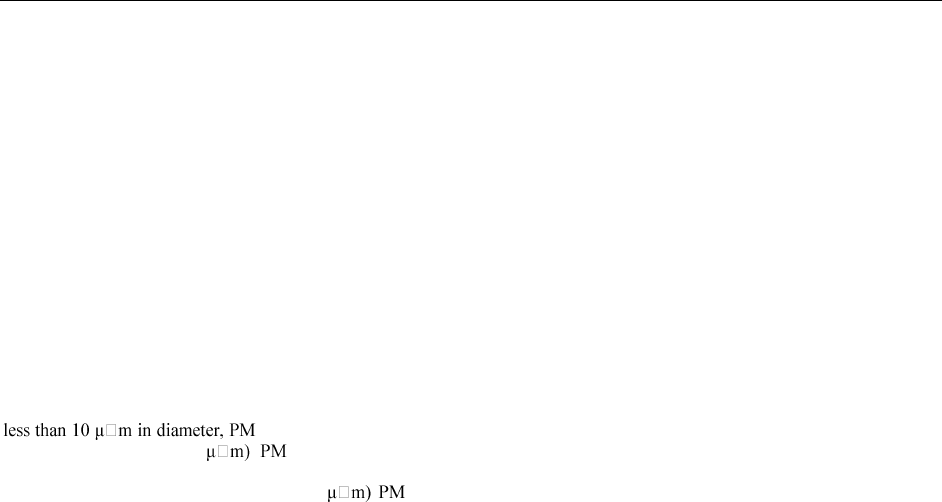
and/or liquid particles of sizes in the range 0.01–100 μm
suspended in air, which occur through natural processes
such as, volcanic eruptions, windblown dust, sea spray, etc.
(greater than 10 μm in diameter), or through anthropogenic
sources like industrial emissions, automobile exhausts, etc.
(less than 10 μm in diameter) [99].
Ambient aerosol particles are responsible for adverse
health effects, creation of haze pollution both in urban and
in the rural area, visibility reduction on human and
influence on climate. On the other hand carbonaceous
aerosols can block solar radiation and scatter visible light
and play an important role in the earth’s radiative balance
and in climate [56]. They are scattered solar radiation and
can act as cloud condensation and ice nuclei [111]. The
main component of carbonaceous aerosol is organic carbon
(OC), which is volatile while the rest is composed of black
carbon (BC). Carbonaceous aerosol is produced during
incomplete combustion of fossil fuels, biofuels, and
biomass burning emissions [55].
Aerosol sources are classified into two types as follows
[12]:
Primary aerosols (>1 μm in diameter) are those
that are emitted into the atmosphere directly as
condensed solids or liquids. For example, sea
salt, mineral dust, desert dust, re-entrained road
dust and soot particles are clearly primary
particles.
Secondary aerosols (between 0.1 and 1 μm in
diameter) are formed within the atmosphere from
gaseous precursors. For example, organic
particles from the oxidation of volatile organic
compounds (VOC) and sulphates from the
oxidation of SO
2
or other sulphur containing
gases are secondary particles.
Aerosols vary in shape, chemical composition and
optical properties. For example, 0.01 to 5 μm solid particles
are paint pigments, tobacco smoke, dust, sea-salt particles;
5 to 100 μm solid particles are cement dust, wind-blown
soil dust, foundry dust, pulverized coal, milled flower; 5 to
10,000 μm liquid particles are fog, smog, mist, raindrops;
0.001 to 0.01 μm biological origin particles are viruses,
bacteria, pollen, spores and 0.001 to 100 μm chemical
formation atmospheric SO
2
and metal oxides form when
fuels that contain metals are burned [121].
Journal of Environmental Treatment Techniques 2015, Volume 3, Issue 4, Pages: 184-200
193
As of 2009, the PB for ‘atmospheric aerosol loading’
had not yet been quantified. Although there are many
assessments and indicators available for particulate air
pollution, such as PM
2.5
(due to the negative influence on
human health), there is not enough scientific knowledge to
quantify the impact at the global scale [102].
Atmospheric aerosols influence climate directly through
scattering and absorbing radiation, and indirectly by acting
as condensation nuclei for clouds [93]. Aerosols may have
weakened the rate of the global warming by some 30%,
possibly up to 50–80% [6].
Aerosols have some effects on environment and human
health as well as the life of plants or animals. According to
World Health Organization (WHO), ozone, particulate,
matter, heavy metals and some hydrocarbons present the
priority pollutants in the troposphere. The results of the
long-term studies confirm that the adverse health effects are
mainly due to particulate matter, especially small particles-
10
[100]. Lifetime of fine
particles (diameter < 2.5
2.5
is from days to
weeks, travel distance ranges from 100 s to >1,000 s km.
Lifetime of coarse particles (diameter <10
10
is
minutes to hours, and their travel distance varies from <1
km to 10 km [121].
Aerosols have deleterious health effects as they often
contain toxins and/or carcinogens that contribute to
cardiopulmonary diseases and mortality [96].
6.8 Ocean Acidification
The basic chemistry of ocean acidification was first
described in the early 1970s, based on early models of CO
2
exchange at the air-sea interface and the thermodynamics
of the carbon system in seawater. Ocean acidification is
closely linked with climate change [10,35,143]. The first
symposium on “The Ocean in a High-CO
2
World” in 2004
proved to be a landmark event in ocean acidification and
also second symposium held in 2008 [16, 91].
When anthropocentric CO
2
increases in the atmosphere
and dissolves in seawater and then creates carbonic acid
(H
2
CO
3
), releases hydrogen ions (H
+
), which increases
acidity. These H
+
increase ocean acidity and reduce calcium
carbonate ion (CO
3
2–
) saturation. It is estimated that the
surface waters of the oceans have taken up about 25% of
the carbon generated by anthropogenic activities since 1800
and altering seawater chemistry. CO
2
is generally less
soluble in warm water than in cold water. As a result,
marine waters near the poles have a much greater capacity
for dissolving CO
2
than do ocean waters in the tropics [11].
Shipping emissions annually release about 9.5 million
tons of sulphur (S) and 16.2 million tons of nitric oxides
(NO). When these dissolved in seawater converted into the
strong sulphuric (H
2
SO
4
) and nitric acids (HNO
3
)
respectively [51]. Ocean acidification effects on food webs,
fisheries (shellfish), marine ecosystems (corals, coralline
algae, mollusks and some plankton), coastal erosion and
tourism [91].
The upper layers of the ocean are now 0.7°C warmer
due to global warming than they were 100 years ago [72].
Since the Industrial Revolution (1750) atmospheric CO
2
has increased. The oceans of the world are absorbing CO
2
at a faster rate than at any time in the past 800,000 years
[86]. Present total human CO
2
emissions are more than 10
billion tons of carbon annually. Of this amount, 8.7±0.5
billion tons originates from fossil fuel combustion and
cement production and another 1.2±0.7 billion tons from
deforestation [70]. The cumulative human CO
2
emissions
over the industrial era now amount to close to 560 billion
tons [27]. Oceanic pH has decreased by 0.1 units, increases
physiological hypercapnia, which has removed 30–40
μmol/kg carbonate ions (CO
3
2–
) from ocean bodies like the
coral sea that normally contain between 250–300 μmol/kg.
Consequently, at present the ocean has become more acidic
(increased by 30%) by changing the ocean’s chemistry and
coral reefs are in threatened position [53]. It is estimated
that surface ocean pH is projected to decrease by 0.4± 0.1
pH units by 2100 relative to pre-industrial conditions [76].
If this situation happens then hundreds of thousands to
millions of years will be needed for coral reefs to be re-
established, based on past records of natural coral reef
extinction events [132].
Increasing concentrations of atmospheric CO
2
is
entering the ocean in ever increasing amounts. CO
2
combines with water to produce carbonic acid
(CO
2
+H
2
O→H
2
CO
3
), which subsequently converts
carbonate ions (H
2
CO
3
→2H
+
+CO
3
2–
) into bicarbonate ions
(2H
+
+CO
3
2–
→H
+
+HCO
3
–
). Some marine organisms use
bicarbonate to form the compound calcium carbonate
(2HCO
3
–
+ Ca
2
+
→CaCO
3
+ CO
2
+ H
2
O). CaCO
3
builds
skeletons as in coral reefs, or protective shells as in snails.
Hence, the decreases in CO
3
2–
, decreases the saturation
state of CaCO
3
[52].
Ocean warming is implicated in mass mortality,
increased disease, hypoxia, coral bleaching, species
invasions, phonological shifts in planktonic food web
dynamics, physiological limitation in oxygen delivery and
increased costs of metabolism [54,95]. Ocean acidification
is a major threat to calcifying marine invertebrates because
it decreases the availability of the CO
3
2–
required for
skeletogenesis, and it exerts a direct pH effect [78].
Hypercapnia has a pervasive narcotic effect suppressing
metabolism [15].
6.9 Chemical Pollution
Hundreds of thousands of different man-made and
natural chemicals are harmful for ecosystem or human
health. The concepts of PBs for chemical pollution are
needed for developing appropriate evaluation strategies to
reduce global chemical risks and the future development of
sustainable chemical technologies [103].
Primary types of chemical pollution are radioactive
compounds, heavy metals (steel, copper, gold etc.), and a
wide range of organic compounds of human origin.
Chemical pollution affects other planetary boundaries, such
as, biodiversity boundary by reducing the abundance of
species and climate change releasing CO
2
by the burning
petroleum when chemicals are produced [102].
Hundreds of tons of hazardous waste are released to the
air, water, and land by industry every hour of every day and
the chemical industry is the biggest source of such waste
[71].
During 1994–2008, Nigeria was the worst for gas
flaring efficiency among the top eight flaring countries. At

Journal of Environmental Treatment Techniques 2015, Volume 3, Issue 4, Pages: 184-200
194
present Nigeria is the second largest gas flaring volume
among the top 20 individual countries. Nigeria and Russia
together account for 40% of global gas flaring and the top
twenty countries account for 85% [31].
It is estimated that there are 80,000 to 100,000
chemicals on the global market [18, 131]. Of the 80,000
chemicals in commerce, 1,000 are known to be neurotoxic
in experiments, 200 are known to be neurotoxic in humans,
and 5 (methyl mercury, arsenic, lead, polychlorinated
biphenyls (PCBs), toluene) are known to be toxic to human
neurodevelopment [102]. According to the California
Policy Research Center, about 2,000 potentially hazardous
chemicals are introduced into commercial use each year.
Global chemical production is expected to double every 25
years, even as global population increases at a much slower
rate. Every day the chemists are inventing new chemicals
and some of them are harmful for human life [82,146].
Twelve most dangerous Persistent Organic Pollutants
(POPs) are collectively referred to as the dirty dozen. The
first 9 are agricultural and landscape chemicals (pesticides)
and last 3 are industrial chemicals. POPs are extremely
toxic chemicals with acute and chronic effects on pests,
wildlife, and humans contact. Their uses, half-life in soil
(years) and effects on human health are given as follows
[127]:
1. Aldrin: Uses as insecticide, half-life in soil is yet
unknown and adverse health effects on human
body are the development of carcinogenic,
malaise, dizziness and nausea.
2. Chlordane: Uses as insect and termite control,
half-life in soil is one year and adverse health
effect on human body is carcinogenic creation.
3. Dichloro-diphenyl-trichloroethane (DDT): Uses
as insecticide, half-life in soil is 10–12 years, and
adverse health effects on human body are the
development of cancer of liver and immune
system suppression.
4. Dieldrin: Uses as insecticide, half-life in soil is 5
years and adverse health effects on human body
are liver and biliary cancer formation.
5. Endrin: Uses as insecticide and rodenticide, half-
life in soil is up to 12 years and adverse health
effect on human body is the development of
cancers.
6. Heptachlor: Uses as insect and termite control,
half-life in soil is up to 2 years and adverse health
effects on human body are the formation of
cancers, mutations, stillbirths, birth defects and
liver disease.
7. Hexachloro-benzene (HCB): Uses as fungicide,
half-life in soil is 2.7–22.9 years and adverse
health effects on human body are the
development of cancers, mutations, birth defects,
fetal and embryo toxicity, nervous disorder and
liver disease.
8. Mirextermiticide: Uses as insecticide, half-life in
soil is up to 10 years, and adverse health effects
on human body are the creation of acute toxicity
and possible cancers.
9. Toxaphane: Uses as insecticide, half-life in soil is
3 months to one year and adverse health effects
on human body are the development of
carcinogenic, chromosome aberrations, liver and
kidney problems.
10. Polychlorinated biphenyls (PCBs): Uses as
industry manufacture, co-planar, half-life in soil
is 10 days to 1.5 year and adverse health effects
on human body are cancers mutations, births
defects, fetal and embryo toxicity, neurological
disorder and liver damage formation.
11. Dioxins: Uses to produce by-product, half-life in
soil is 10–12 years and adverse health effects on
human body are the development of peripheral
neuropathies, fatigue, depression, liver disease
and embryo toxicity.
12. Furans: Uses to produce by-product, half-life in
soil is 10–12 years and adverse health effects on
human body are the development of peripheral
neuropathies, embryo toxicity and liver problems.
Pulp and paper industry is considered as one of the
most polluter industry in the world. The wastewaters
generated from production processes of this industry
include high concentration of chemicals such as sodium
hydroxide (NaOH), sodium carbonate (Na
2
CO
3
), sodium
sulfide (Na
2
S), bisulfites, elemental chlorine or chlorine
dioxide (Cl
2
O), calcium oxide (CaO), hydrochloric acid
(HCl), etc. [120].
According to the Environmental Protection Agency
(EPA), the average adult breathes 3,000 gallons of air per
day. Inhaling certain air pollutants can worsen conditions
such as asthma, and studies estimate that thousands of
people die prematurely each year due to air pollution [115].
Sulphur dioxide (SO
2
) is a poisonous gas that released by
volcanoes and in various industrial processes (by roasting
metal sulphide ores). It has a variety of industrial
applications, from refining raw materials for preserving
food. The poisonous gas SO
2
is considered as a local
pollution problem worldwide. It is emitted in the
atmosphere from both anthropogenic and natural sources. It
is estimated that anthropogenic sources account for more
than 70% of SO
2
global emissions, half of which are from
fossil-fuel combustion [139]. It is considered as severe
health effect ingredient, both in short-term and long-term
[83].
The health effects caused by a short-term (a few
minutes) exposures to SO
2
are as follows [5]:
(a) difficulty in breathing, (b) coughing, (c) irritation of the
nose, throat, lungs, (d) fluid in lungs, (e) shortness of breath
and (f) forms sulphuric acid in lungs.
The health effects caused by long-term exposure to SO
2
are as follows [5]:
(a) temporary loss of smell, (b) headache, (c) nausea, (d)
dizziness, (e) irritation of lungs, (f) phlegm, (g) coughing,
(h) shortness of breath, (i) bronchitis and (j) reduced
fertility.
At present China becomes the highest SO
2
emitter in
the world due to its reliance on coal for energy generation.
When SO
2
combines with moisture in the atmosphere, it
can form sulphuric acid (H
2
SO
4
), which is the main
component of acid rain. Acid rain destroys various living
organisms (harmful for humans, animals and vegetation)

Journal of Environmental Treatment Techniques 2015, Volume 3, Issue 4, Pages: 184-200
195
and structures (paints, buildings, infrastructure and cultural
resources) [83]. The World Health Organization (WHO)
estimated that acid rain seriously affects 30% of China’s
total land area [140].
Green chemistry and engineering (GCE) involves
designing and using chemical products and processes with
the aim of eliminating or reducing their negative impact on
human health and the environment [82].
On 10 September 2010, California’s Department of
Toxic Substances Control (DTSC) submitted its Green
Chemistry Proposed Regulation for Safer Consumer
Products to the state’s Office of Administrative Law,
triggering a 45-day public comment period and formal
rulemaking process, which flesh out a process for
identifying and prioritizing chemicals in consumer products
that may be subject to additional restrictions [25].
7 Progress in Environment Protection
The Thames in London, have been cleaned up and the
air quality in major cities, such as Los Angeles, is better.
Synthetic pesticides once sprayed on our crops, such as
DDT, have been banned in most developed countries, and
lead has been removed from petroleum-based fuels.
Even though the major 12 Persistent Organic Pollutants
(POPs) have now been banned or restricted in most
industrialized countries, but these chemicals continue to be
produced and exported to Third World countries where
regulations are negligent [1]. The USA, China and other
industrialized countries agreed to reduce GHG emissions.
Six dimensions of transformation for sustainability are
as follows [105]:
i. Global energy transformation (>80% reduction in
CO
2
emissions by 2050).
ii. Food security transformation (+70% by 2050;
sustainable intensification).
iii. Urban sustainability transformation.
iv. The population transition (aim for a 9 billion
world or below).
v. The biodiversity management transformation
(protect, restore, manage; sustain critical biomes).
vi. Private and public governance transformation
(strengthen global governance).
8 Conclusions
In this study we have discussed the aspects of nine
planetary boundaries. Beyond of these boundaries
anthropogenic change will put the earth system outside a
safe operating space for humanity. Four boundaries;
climate change, loss of biosphere integrity, land-system
change and altered biogeochemical cycles have already
been passed due to human activities. Scientists estimated
that within a very short time world will face the difficulties
of shortage of freshwater, change in land use, ocean
acidification and interference with the global phosphorous
cycle. In 2014 the population of the world became 7.29
billion and world population is growing continuously. For
this vast population the world faces various problems and
the 21
st
century becomes a challenge for the survival of the
mankind. At the same time industrial and anthropogenic
activities have increased air pollution which affect on
human health. It is the critical period that all the nations
should take attempts to make the earth safe shelter for all
living creatures.
References
1- Adeola, F.A. (2004), Boon or Bane? The
Environmental and Health Impacts of Persistent
Organic Pollutants (POPs), Research in Human
Ecology, 11(1): 27–35.
2- Alternative Fluorocarbons Environmental
Acceptability Study, AFEAS (1995), Washington, DC.
3- Alkasassbeh, M. (2013), Predicting of Surface Ozone
Using Artificial Neural Networks and Support Vector
Machines, International Journal of Advanced Science
and Technology, 55: 1–12.
4- Anderson, J.G.; Grassl, H.J.; Shetter, R.E. and
Margitan, J.J. (1981), HO
2
in the Stratosphere: 3 In-
situ Observations, Geophysical Research Letters, 8(3):
289–292.
5- Bureau of Community and Environmental Health
(BCEH) (2001), Sulfur Dioxide Fact Sheet,
Environmental Health Education and Assessment,
Idaho Department of Health & Welfare.
6- Bellouin, N.; Boucher, O.; Haywood, J. and Reddy,
M.S. (2005), Global Estimate of Aerosol Direct
Radiative Forcing from Satellite Measurements,
Nature, 438: 1138–1141.
7- Bennett, E. and Carpenter, S. (2002), P Soup: The
Global Phosphorus Cycle, Worldwatch Institute,
Washington, DC.
8- Bennett, E.M.; Carpenter, S.R. and Caraco, N.E.
(2001), Human Impact on Erodable Phosphorus and
Eutrophication: A Global Perspective, BioScience, 51:
227–234.
9- Black, R. (2011), Polar Ice Loss Quickens, Raising
Seas, BBC News, 9 March.
10- Broecker, W.S.; Takahashi, T.; Simpson, H.J. and
Peng, T.-H. (1979), Fate of Fossil Fuel Carbon
Dioxide and the Global Carbon Budget, Science, 206:
409–418.
11- Buck, E.H. and Folger, P. (2011), ‘Ocean
Acidification’ in S E Haffhold, Encyclopedia of Water
Pollution: 1819–1820.
12- Buseck, P.R. and Po´sfai, M. (1999), Airborne
Minerals and Related Aerosol Particles: Effects on
Climate and the Environment, The Proceedings of the
National Academy of Sciences (PNAS), 96: 3372–
3379.
13- Carroll, S.B. and Salt, S.D. (2004), Ecology for
Gardeners, Timber Press.
14- Chapin III, S.F.; Matson, P.A. and Mooney, H.A.
(2002), Principles of Terrestrial Ecosystem Ecology,
Springer, New York.
15- Christensen, A.B.; Nguyen, H.D. and Byrne, M.
(2011), Thermotolerance and the Effects of
Hypercapnia on the Metabolic Rate of the Ophiuroid
Ophionereis Schayeri: Inferences for Survivorship in a
Changing Ocean, Journal of Experimental Marine
Biology and Ecology, 403(1–2): 31–38.
16- Cicerone, R.; Orr, J.; Brewer, P.; Haugan, P.; Merlivat,
L.; Ohsumi, T.; Pantoja, S.; Poertner, H.-O.; Hood, M.

Journal of Environmental Treatment Techniques 2015, Volume 3, Issue 4, Pages: 184-200
196
and Urban, E. (2004), Meeting Report: The Ocean in a
High-CO
2
World, Oceanography, 17(3): 72–78.
17- Ciriacy-Wantrup, S.V. (1952), Resource
Conservation: Economics and Policies, University of
California Press, Berkeley, California, USA.
18- Commission of the European Communities (2001),
White Paper: Strategy for Future Chemicals Policy,
(COM2001 88 final), Commission of the European
Communities, Brussels, EU.
19- Corcoran, E.; Nellemann, C.; Baker, E.; Bos, R.;
Osborn, D. and Savelli, H. (Eds.) (2010), Sick Water?
The Central Role of Wastewater Management in
Sustainable Development, A Rapid Response
Assessment, United Nations Environment Programme,
UN-HABITAT, GRID-Arendal.
20- Cordell, D. (2010), The Story of Phosphorus:
Sustainability Implications of Global Phosphorus
Scarcity for Food Security, PhD Thesis, Linköping
University, Sweden.
21- Crutzen, P.J. (2002), Geology of Mankind, Nature,
415 (6867): 23.
22- Daly, H.E. (1977), Steady-state Economics; Science
and Society, W. H. Freeman and Co, New York.
23- Daly, H.E. and Cobb, J.B. (1989), For the Common
Good: Redirecting the Economy toward Community,
the Environment and a Sustainable Future, Beacon
Press, Boston.
24- Dansgaard, W.; Johnsen, S.J.; Clausen, H.B.; Dahl-
Jensen, D.; Gundestrup, N.S.; Hammer, C.U.;
Hvidberg, C.S.; Steffensen, J.P.; Sveinbjörnsdottir,
A.E.; Jouzel, J. and Bond, G. (1993), Evidence for
General Instability of Past Climate from a 250-kyr Ice-
core Record, Nature, 364: 218–220.
25- Defining Green Products (2010), Air Quality Sciences,
Inc., Atlanta.
26- Diaz, R.J. and Rosenberg, R. (2008), Spreading Dead
Zones and Consequences for Marine Ecosystems,
Science, 321: 926–929.
27- Doney, S.C.; Balch, W.M.; Fabry, V.J. and Feely,
R.A. (2009), Ocean Acidification: A Critical
Emerging Problem for the Ocean Sciences,
Oceanography, 22(4): 16–25.
28- Drechsel, P.; Scott, C.A.; Raschid-Sally, L.; Redwood,
M. and Bahri, A. (Eds.) (2010), Wastewater Irrigation
and Health, Assessing and Mitigating Risk in Low-
Income Countries, International Water Management
Institute (IWMI)-International Development Research
Centre (IDRC), Earthscan.
29- EIA (2011), Annual Energy Outlook 2011 With
Projections to 2035: 62,
http://www.eia.gov/forecasts/aeo/pdf/0383(2011).pdf.
30- Elser, J.J.; Bracken, M.E.S.; Cleland, E.E.; Gruner,
D.S.; Harpole, W.S.; Hillebrand, H.; Ngai, J.T.;
Seabloom, E.W.; Shurin, J.B. and Smit, J.E. (2007),
Global Analysis of Nitrogen and Phosphorus
Limitation of Primary Producers in Freshwater,
Marine and Terrestrial Ecosystems, Ecology Letters,
10: 1135–1142.
31- Elvidge, D.; Ziskin, D.; Baugh, B.; Tuttle, B.; Ghosh,
T.; Pack, D.; Erwin, E. and Zhizhin, M.A. (2009),
Fifteen Year Record of Global Natural Gas Flaring
Derived from Satellite Data, Energies, 2(3): 595–622.
32- Emsley, J. (2000), The 13
th
Element: The Sordid Tale
of Murder, Fire, and Phosphorus, John Wiley & Sons,
New York.
33- EPA (2012), Safe and Sustainable Water Resources,
Strategic Research Action Plan 2012–2016.
34- Fahey, D.W. (2002), Twenty Questions and Answers
about the Ozone Layer, A Review Meeting by the 74
Scientists for the Ozone Assessment, Les Diablerets,
Switzerland, 24–28 June 2002.
35- Fairhall, A.W. (1973), Accumulation of Fossil CO
2
in
Atmosphere and Sea, Nature, 245: 20–23.
36- Figuères, C.M.; Tortajada, C. and Rockström, J. (Eds.)
(2003), Rethinking Water Management, Innovative
Approaches to Contemporary Issues Earthscan
Publications Ltd. London, Sterling, VA.
37- Food and Agriculture Organization (FAO) (2007),
Making Every Drop Count: FAO Heads UN Water
Initiative, FAO.org: FAO Newsroom.
38- FAO (2008), FAOSTAT Database Collections, Food
and Agriculture Organization of the UN, Rome.
39- Foley, J.A.; DeFries, R.; Asner, G.P.; Carol, B.C.;
Bonan, G.; Carpenter, S.R.; Chapin, F.S.; Coe, M.T.;
Daily, G.C.; Gibbs, H.K.; Helkowski, J.H.; Holloway,
T.; Howard, E.A.; Kucharik, C.J.; Monfreda, C.; Patz,
J.A.; Prentice, I.C.; Ramankutty, N. and Snyder, P.K.
(2005), Global Consequences of Land Use, Science,
309: 570–574.
40- Fowler, D.; Steadman, C.E.; Stevenson, D.; Coyle, M.;
Rees, R.M.; Skiba, U.M.; Sutton, M.A.; Cape, J.N.;
Dore, A.J.; Vieno, M.; Simpson, D.; Zaehle, S.;
Stocker, B.D.; Rinaldi, M.; Facchini, M.C.; Flechard,
C.R.; Nemitz, E.; Twigg, M.; Erisman, J.W. and
Galloway J.N. (2015), Effects of Global Change
During the 21
st
Century on the Nitrogen Cycle,
Atmospheric Chemistry and Physics, 15: 1747–1868.
41- Fraiser, L. (2015), News Briefs, Zephyr Environmental
Corporation, Austin, Texas.
42- Galaz, V.; Biermann, F.; Folke, C.; Nilsson, M. and
Olsson, P. (2012), Global Environmental Governance
and Planetary Boundaries: An Introduction,
Ecological Economics, Elsevier, 81: 1–3.
43- Galaz, V.; Biermann, F.; Crona, B.; Loorbach, D.;
Folke, C.; Olsson, P.; Nilsson, M.; Allouche, J.;
Persson, Å. and Reischl, G. (2011), Planetary
Boundaries-Exploring the Challenges for Global
Environmental Governance, Beijer Discussion Paper
Series No. 230, The Beijer Institute of Ecological
Economics, The Royal Swedish Academy of Sciences,
Stockholm, Sweden.
44- Galloway, J.N. and Cowling, E.B. (2002), Reactive
Nitrogen and the World: 200 Years of Change, Ambio,
31: 64–71.
45- Galloway, J.N.; Dentener, F.J.; Capone, D.G.; Boyer,
E.W.; Howarth, R.W.; Seitzinger, S.P.; Asner, G.P.;
Cleveland, C.; Green, P.; Holland, E.; Karl, D.M.;
Michaels, A.F.; Porter, J.H.; Townsend, A. and
Vörösmarty, C. (2004), Nitrogen Cycles: Past, Present,
and Future, Biogeochemistry, 70: 153–226.

Journal of Environmental Treatment Techniques 2015, Volume 3, Issue 4, Pages: 184-200
197
46- Garpe, K.C.; Yahya, S.; Lindahl, U. and Öhman, M.C.
(2006), Long-term Effects of the 1998 Coral
Bleaching Event on Reef Fish Assemblages, Marine
Ecology Progress Series, 315: 237–247.
47- Greenwood, N.N. and Earnshaw, A. (1986), Chemistry
of the Elements, Oxford, UK: Pergamon Press.
48- Gru¨bler, A.; Jefferson, M.; McDonald, A.; Messner,
S.; Nakichenovich, N.; Rogner, H.-H. and
Schratzenholzer, L. (1995), Global Energy
Perspectives to 2050 and Beyond, World Energy
Counc./Int., International Institute for Applied Systems
Analysis (IIASA), Laxenburg, Austria.
49- Handoh, I.C. and Lenton, T.M. (2003), Periodic Mid-
Cretaceous Oceanic Anoxic Events Linked by
Oscillations of the Phosphorus and Oxygen
Biogeochemical Cycles, Global Biogeochemical
Cycles, 17: 1092–1103.
50- Hansen, J.; Sato, M.; Ruedy, R.; Lo, K.; Lea, D.W.
and Elizade, M.M. (2006), Global Temperature
Change, PNAS, 103(39): 14288–14293.
51- Hassellöv, I-M.; Turner, D.R.; Lauer, A. and Corbett,
J.J. (2013), Shipping Contributes to Ocean
Acidification, Geophysical Research Letters, 40.
52- Hoegh-Guldberg, O. and Hoegh-Guldberg, H. (2008),
The Impact of Climate Change and Ocean
Acidification on the Great Barrier Reef and its Tourist
Industry, Garnaut Climate Change Review, 1–33.
53- Hoegh-Guldberg, O.; Mumby, P.J.; Hooten, A.J.;
Steneck, R.S.; Greenfield, P.; Gomez, E.; Harvell
D.R.; Sale, P.F.; Edwards, A.J.; Caldeira, K.;
Knowlton, N.; Eakin, C.M.; Iglesias-Prieto, R.;
Muthiga, N.; Bradbury, R.H.; Dubi, A. and Hatziolos,
M.E. (2007), Coral Reefs under Rapid Climate
Change and Ocean Acidification, Science, 318: 1737–
1742.
54- Hofmann, G.E. and Todgham, A.E. (2010), Living in
the Now: Physiological Mechanisms to Tolerate a
Rapidly Changing Environment, Annual Review of
Physiology, 72: 127–145.
55- Horvath, H. (1993), Atmospheric Light Absorption-A
Review, Atmospheric Environment 27A: 293–317.
56- The Intergovernmental Panel on Climate Change,
IPCC (2007), Climate Change 2007: The Physical
Science Basis, Synthesis Report of the IPCC Fourth
Assessment Summary for Policymakers, Cambridge
University Press.
57- Isac, L.; Dumitrescu, L.; Drăgan, D.; Manciulea, I. and
Ţică, R. (2003), The Phosphorus Biogeochemical
Cycle in Braşov District Lakes, Ovidius University
Annals of Chemistry, 14(1): 24–27.
58- Jasinski, S.M. (2009), Phosphate Rock, Mineral
Commodity Summaries, US Geological Survey,
January, 2009.
59- Jing, H. (2012), Preparation of Tio2/Acf in
Caprolactam Tetrabutyl Ammonium Bromide Ionic
Liquid, Proceedings of the 2012 International
Conference on Biomedical Engineering and
Biotechnology, ICBEB ’12, (Washington, DC, USA),
IEEE Computer Society: 1610–1613.
60- Johnson, A.W. and Earle, T.K. (2000), The Evolution
of Human Societies: From Foraging Group to
Agrarian State, Palo Alto, CA, USA: Stanford
University Press.
61- Johnson, C.; Albrecht, G.; Kettrings, Q.; Beckman, J.
and Stockin, K. (2005), Nitrogen Basics–The Nitrogen
Cycle, Agronomy Fact Sheet Series, Fact Sheet 2,
Cornell University, Cooperative Extension.
62- Johnston, A.E. (2000), Soil and Plant Phosphate,
International Fertilizer Industry Association (IFA),
Paris.
63- Kataoka, Y. (2002), Overview Paper on Water for
Sustainable Development in Asia and the Pacific,
Asia-Pacific Forum for Environment and Development
first Substantive Meeting, January 12–13, 2002,
Bangkok, Thailand.
64- Kerschner, C. and Cordell, D. (2007), Governing
Global Resource Peaks: The Case of Peak Oil and
Peak Phosphorus, Proceedings of the Institutional
Analysis of Sustainability Problems, Marie Curie
Emerging Theories and Methods in Sustainability
Research series, Bratislava.
65- Khagram, S.; Clark, W.C. and Raad, D.F. (2003),
From the Environment and Human Security to
Sustainable Security and Development, Journal of
Human Development, 4(2): 289–313.
66- Koomen, E.; Rietveld, P. and de Nijs, T. (2008),
Modeling Land-Use Change for Spatial Planning
Support, The Annals of Regional Science, 42:1–10.
67- Lambin, E.F.; Geist, H.J. and Lepers, E. (2003),
Dynamics of Land-Use and Land-Cover Change in
Tropical Regions, Annual Review of Environment and
Resources, 28: 205–241.
68- Lary, D.J. (1997), Catalytic Destruction of
Stratospheric Ozone, Journal of Geophysical
Research, 102(D17): 21,515–21,526.
69- LeBauer, D. and Treseder, K. (2008), Nitrogen
Limitation of Net Primary Productivity in Terrestrial
Ecosystems is Globally Distributed, Ecology, 89: 371–
379.
70- LeQuere, C.; Raupach, M.R.; Canadell, J.G.;
Marland, G.; Bopp, L.; Ciais, P.; Conway, T.J.;
Doney, S.C.; Feely, R.A.; Foster, P. et al. (2009),
Trends in the Sources and Sinks Carbon Dioxide,
Nature Geoscience, 2:831–836.
71- Lomborg, B. (2001), The Skeptical Environmentalist,
Measuring the Real State of the World, Cambridge
University Press, Cambridge.
72- Lough, J. (2007), Climate and Climate Change on the
Great Barrier Reef Chapter 2, In: Climate Change and
the Great Barrier Reef a Vulnerability Assessment, J.
Johnson and P. Marshall Eds., Great Barrier Reef
Marine Park Authority and Australian Greenhouse
Office, Australia.
73- Mace, G.M.; Reyers, B.; Alkemade, R.; Biggs, R.;
Chapin III, F.S.; Cornell, S.E.; Dı´az, S.; Jennings, S.;
Leadley, P.; Mumby, P.J.; Purvis, A.; Scholes, R.J.;
Seddon, A.W.R.; Solan, M.; Steffen, W. and
Woodward, G. (2014), Approaches to Defining a
Planetary Boundary for Biodiversity, Global
Environmental Change, 28: 289–297.

Journal of Environmental Treatment Techniques 2015, Volume 3, Issue 4, Pages: 184-200
198
74- Machenzie, F.T.; Ver, L.M. and Lerman, A. (2002),
Century-scale Nitrogen and Phosphorus Controls of
the Carbon Cycle, Chemical Geology, 190: 13–32.
75- McKinsey & Company (2009), Charting Our Water
Future: Economic Frameworks to Inform Decision-
Making, The 2030 Water Resources Group.
76- Meehl, G.A.; Stocker, T.F.; Collins, W.D.;
Friedlingstein, P.; Gaye, A.T.; Gregory, J.M.; Kitoh,
A.; Knutti, R.; Murphy, J.M.; Noda, A.; Raper, S.C.B.;
Watterson, I.G.; Weaver, A.J. and Zhao, Z.-C. (2007),
Global Climate Projections, Chapter 10 in Climate
Change 2007: The Physical Science Basis.
Contribution of Working Group I to the Fourth
Assessment Report of the Intergovernmental Panel on
Climate Change, [S. Solomon, D. Qin, M. Manning,
Z. Chen, M. Marquis, K.B. Averyt, M. Tignor, and
H.L. Miller, (Eds.)], Cambridge University Press,
Cambridge, UK and New York, NY, USA.
77- Meinshausen, M. (2007), Background Note on a
Stylized Emission Path, Human Development Report
Office Occasional Paper.
78- Melzner, F.; Gutowska, M.A.; Langenbuch, M.;
Dupont, S.; Lucassen, M.; Thorndyke, M.C.; Bleich,
M. and Portner, H.-O. (2009), Physiological Basis for
High CO
2
Tolerance in Marine Ectothermic Animals:
Preadaptation through Lifestyle and Ontogeny?
Biogeosciences, 6: 2313–2331.
79- Meyer, W.B. and Turner, B.L. (2007), Changes in
Land Use and Land Cover, Cambridge University
Press, Cambridge.
80- Millennium Ecosystem Assessment (2005),
Ecosystems and Human Well-Being: Synthesis,
Washington, DC: Island Press.
81- Mohajan, H.K. (2011), Greenhouse Gas Emissions
Increase Global Warming, International Journal of
Economic and Political Integration, 1(2): 21–34.
82- Mohajan, H.K. (2012), Importance of Green
Marketing at Present and Future, Lambert Academic
Publishing, Germany.
83- Mohajan, H.K. (2014), Chinese Sulphur Dioxide
Emissions and Local Environment Pollution,
International Journal of Scientific Research in
Knowledge, 2(6): 265–276.
84- Mohajan, H.K. (2015), Sustainable Development
Policy of Global Economy, American Journal of
Environmental Protection, 3(1): 12–29.
85- Molina, M. and Rowland, F.S. (1974), Stratospheric
Sink for Chlorofluoromethanes: Chlorine Atom
Catalyzed Destruction of Ozone, Nature, 249: 810–
812.
86- Moore, C.C. (2011), Welfare Impacts of Ocean
Acidification: An Integrated Assessment Model of the
US Mollusk Fishery, US EPA National Center for
Environmental Economics (NCEE) Working Paper
Series, Working Paper # 11–06.
87- National Research Council, NRC (2004), Confronting
the Nation’s Water Problems: The Role of Research,
National Academies Press, Washington, DC.
88- Nykvist, B.; Persson, Å.; Moberg, F.; Persson, L.;
Cornell, S. and Rockström, J. (2013), National
Environmental Performance on Planetary Boundaries,
A study for the Swedish Environmental Protection
Agency, The Stockholm Environment Institute.
89- Odum, E.P. (1989), Ecology and Our Endangered
Life-support Systems, Sinuaer Associates, Sunderland,
Massachusetts, USA.
90- Öhman, M.C. and Rajasuriya, A. (1998),
Relationships between Habitat Structure and Fish
Communities on Coral and Sandstone Reefs,
Environmental Biology of Fishes, 53: 19–31.
91- Orr, J.C.; en Caldeira, K.; Fabry, V.; Gattuso, J-P.;
Haugan, P.; Lehodey, P.; Pantoja, S.; Pörtner, H-O.;
Riebesell, U.; Trull, T.; Urban, E.; Hood, M. and
Broadgate, W. (2009), Research Priorities for
Understanding Ocean Acidification Summary from the
Second Symposium on the Ocean in a High-CO
2
World, Oceanography, 22(4): 182–189.
92- Paytan, A. and McLaughlin, K. (2007), The Oceanic
Phosphorus Cycle, Chemical Reviews, 107: 563–576.
93- Pio, C.A.; Legrand, M.; Oliveira, T.; Afonso, J.;
Santos, C.; Caseiro, A.; Fialho, P.; Barata, F.;
Puxbaum, H.; Sanchez-Ochoa, A.; Kasper-Giebl, A.;
Gelencse´r, A.; Preunkert, S. and Schock, M. (2007),
Climatology of Aerosol Composition (Organic Versus
Inorganic) at Nonurban Sites on a West-East Transect
Across Europe, Journal of Geophysical Research, 112,
D23S02: 1–15.
94- Pisano, U. and Berger, G. (2013), Planetary
Boundaries for SD from a Conceptual Perspective to
National Applications, European Sustainable
Development Network (ESDN) Quarterly Report, 30–
October 2013.
95- Portner, H.O. (2010), Oxygen- and Capacity-
Limitation of Thermal Tolerance: A Matrix for
Integrating Climate Related Stressor Effects in Marine
Ecosystems, Journal of Experimental Biology, 213:
881–893.
96- Pöschl, U. (2005), Atmospheric Aerosols:
Composition, Transformation, Climate and Health
Effects, Angewandte Chemie International Edition,
44(46): 7520–7540.
97- Purves, W.K.; Sadava, D.; Orions, G.H. and Heller, C.
(2004), Life, The Science of Biology, 7
th
Ed., Sinauer
Assoc. and W. H. Freeman, Sunderland, Mass.
98- Rabalais, N.N. (2002), Nitrogen in Aquatic
Ecosystems, Ambio, 31: 102–112.
99- Rao, M.N. and Rao, H.V.N. (1989), Air Pollution,
Tata McGraw-Hill Publishing Company, New Delhi.
100- Revenga, C.; Brunner, J.; Henninger, N.; Kassem,
K. and Payne, R. (2000), Pilot Analysis of Global
Ecosystems: Freshwater Systems, World Resources
Institute, Washington, DC.
101- Rimal, B. (2011), Application of Remote Sensing
and Geographical Information Systems (GIS), Land
Use/Land Cover Change in Kathmandu, Journal of
Theoretical and Applied Information Technology,
3(2): 80–86.
102- Rockström, J.; Steffen, W.; Noone, K.; Persson,
Å.; Chapin III, F.S.; Lambin, E.; Lenton, T.M.;
Scheffer, M.; Folke, C.; Schellnhuber, H.; Nykvist, B.;
de Wit, C.A.; Hughes, T.; van der Leeuw, S.; Rodhe,
H.; Sörlin, S.; Snyder, P.K.; Costanza, R.; Svedin, U.;

Journal of Environmental Treatment Techniques 2015, Volume 3, Issue 4, Pages: 184-200
199
Falkenmark, M.; Karlberg, L.; Corell, R.W.; Fabry,
V.J.; Hansen, J.; Walker, B.; Liverman, D.;
Richardson, K.; Crutzen, P. and Foley, J.A. (2009a),
Planetary Boundaries: Exploring the Safe Operating
Space for Humanity, Ecology and Society, 14(2): 32.
2009a.
103- Rockström, J.; Steffen, W.; Noone, K.; Persson.
Å.; Chapin III, F.S.; Lambin, E.F.; Lenton, T.M.;
Scheffer, M.; Folke, C.; Schellnhuber, H.J.; Nykvist,
B.; de Wit, C.A.; Hughes, T.; van der Leeuw, S.;
Rodhe, H.; Sörlin, S.; Snyder, P.K.; Costanza, R.;
Svedin, U.; Falkenmark, M.; Karlberg, L.; Corell,
R.W.; Fabry, V.J.; Hansen, J.; Walker, B.; Liverman,
D.; Richardson, K.; Crutzen, P. and Foley, J.A.
(2009b), A Safe Operating Space for Humanity,
Nature, 461: 472–475.
104- Rockström, J. and Klum, M. (2012), The Human
Quest Stockholm, Stockholm Text Publishing AB.
105- Rockström, J.; Sachs, J.D.; Öhman, M.C. and
Schmidt-Traub, G. (2013), Sustainable Development
and Planetary Boundaries, Background Research
Paper, High Level Panel on the Post-2015
Development Agenda, Sustainable Development
Solution Network, A Global Initiative for the United
Nations (Manuscript Submitted).
106- Rodwan, J.G. (2011), Bottled Water 2011: The
Recovery Continues, US and International
Developments and Statistics.
107- Sachs, J.D. (2014), Sustainable Development
Goals for a New Era, Horizons, 1: 106–119.
108- Schlesinger, W.H. (2009), Thresholds Risk
Prolonged Degradation, Nature Reports 1, (October
2009): 112–113.
109- Schröder, J.J. (2014), The Position of Mineral
Nitrogen Fertilizer in Efficient Use of Nitrogen and
Land: A Review, Natural Resources, 5: 936–948.
110- Schwartz, J.; Dochery, D.W. and Neas, L.M.
(1996), Is Daily Mortality Associated Specifically
with Fine Particles, Journal of the Air & Waste
Management Association, 46(10): 927–939.
111- Seinfeld, J.H. and Pandis, S.N. (1998),
Atmospheric Chemistry and Physics: From Air
Pollution to Climate Change, John Wiley and Sons,
New York.
112- Sivasakthivel, T. and Reddy, K.K.S.K. (2011),
Ozone Layer Depletion and its Effects: A Review,
International Journal of Environmental Science and
Development, 2(1): 30–37.
113- Smaling, E.; Toure, M.; Ridder, N., Sanginga, N.
and Breman, H. (2006), Fertilizer Use and the
Environment in Africa: Friends or Foes?, Background
Paper Prepared for the African Fertilizer Summit, June
9–13, 2006, Abuja, Nigeria.
114- Smil, V. (2000), Cycles of Life, Scientific
American Library, New York.
115- Sola, J. (2015), Engineers are Making Strides in
Reducing Air Pollution, PHYS-ORG, University of
Wisconsin-Madison.
116- Steffen, W.; Crutzen, P.J. and McNeill, J.R.
(2007), The Anthropocene: Are Humans Now
Overwhelming the Great Forces of Nature?, Ambio,
36: 614–621.
117- Steffen, W.; Persson, Å.; Deutsch, L.; Zalasiewicz,
J.; Williams, M.; Richardson, K.; Crumley, C.;
Crutzen, P.; Folke, C.; Gordon, L.; Molina, M.;
Ramanathan, V.; Rockström, J.; Scheffer, M.;
Schellnhuber, H.J. and Svedin, U. (2011), The
Anthropocene: From Global Change to Planetary
Stewardship, Ambio, 40: 739–761.
118- Steffen, W.; Richardson, K.; Rockström, J.;
Cornell, S.E.; Fetzer, I.; Bennett, E.; Biggs, R.;
Carpenter, S.R.; de Vries, W.; de Wit, C.A.; Folke, C.;
Gerten, D.; Heinke, J.; Mace, G.M.; Persson, L.M.;
Ramanathan, V.; Reyers, B. and Sörlin, S. (2015),
Planetary Boundaries: Guiding Human Development
on a Changing Planet, Science, 347(6223): 1–17.
119- Stern, N. (2007), Stern Review: The Economics of
Climate Change, HM Treasury.
120- Sumathi, S. and Hung, Y.T. (2006), Treatment of
Pulp and Paper Mill Wastes, In: Waste Treatment in
the Process Industries. Eds.: L. K. Wang, Y. T. Hung,
H. H. Lo, C. Yapijakis, pp. 453–497, Taylor &
Francis, USA.
121- Tasić, M.; Rajšić, S.; Novaković, V. and Mijić, Z.
(2006), Atmospheric Aerosols and their Influence on
Air Quality in Urban Areas, Facta Universitatis
Series: Physics, Chemistry and Technology, 4(1): 83–
91.
122- The Economics of Ecosystems and Biodiversity,
TEEB (2010), The Economics of Ecosystems and
Biodiversity: Mainstreaming the Economics of Nature:
A Synthesis of the Approach, Conclusions and
Recommendations of TEEB, European Commission,
Brussels.
123- Turner, R.E.; Rabalais, N.N.; Justic, D. and
Dortch, Q. (2003), Global Patterns of Dissolved N, P
and Si in Large Rivers, Biogeochemistry, 64: 297–
317.
124- Turner, K.; Georgiou, S.; Clark, R. and Roy, B.
(2004), FAO.org.Rep. Food and Agriculture
Organization of the United Nations.
125- Uchiyama, Y.; Fujisawa, R; Oda, Y. and
Hirasawa, E. (1999), Air Conditioner and Washing
Machine Primary Disassembly Process, Proceedings
of the First international Conference on
Environmentally Conscious Design and Inverse
Manufacturing, Eco-design ’99, (Washington, DC,
USA), IEEE Computer Society: 258–262.
126- United Nations Development Program (UNDP)
(2007), Human Development Report 2007/2008, New
York, Palgrave Macmillan.
127- United Nations Environmental Program (UNEP),
(2000), Report of the Intergovernmental Negotiating
Committee for an International Legally Binding
Instrument for Implementing International Action on
Certain Persistent Organic Pollutants on the Work of
its Fifth Session, Geneva: UNEP/POPS/INC.5/7.
128- UNEP (1987), The 1987 Montreal Protocol on
Substances that Deplete the Ozone Layer, as Adjusted
and Amended by the Second Meeting of the Parties
(London, 27–29 June 1990) and by the Fourth Meeting

Journal of Environmental Treatment Techniques 2015, Volume 3, Issue 4, Pages: 184-200
200
of the Parties (Copenhagen, 23–25 November 1992)
and Further Adjusted by the Seventh Meeting of the
Parties (Vienna, 5–7 December 1995) and Further
Adjusted and Amended by the Ninth Meeting of the
Parties (Montreal, 15–17 September 1997). Available
at: http://www.unep.org.
129- UNEP (2012), UNEP Global Environmental Alert
Service: Measuring Progress, Environmental Goals
and Gaps, December 2012.
130- UNESCO (2003), United Nation’s World Water
Development Report Part II, Water for people, Water
for Life: A Look at the World’s Freshwater Resources,
UNESCO.
131- U.S. Environmental Protection Agency (EPA)
(1998), Chemical Hazard Data Availability Study:
What Do We Really Know about the Safety of High
Production Volume Chemicals? Office of Pollution
Prevention and Toxics, Washington, DC, USA.
132- Veron, J.E.N. (2008), A Reef in Time: The Great
Barrier Reef from Beginning to End, Belknap Press.
133- Vitousek, P.M.; Aber, J.; Howarth, R.W.; Likens,
G.E.; Matson, P.A.; Schindler, D.W.; Schlesinger,
W.H. and Tilman, G.D. (1997a), Human Alteration of
the Global Nitrogen Cycle: Sources and
Consequences, Issues in Ecology, 1(3): 1–17.
134- Vitousek, P.M.; Mooney, H.A.; Lubchenco, J. and
Melillo, J.M. (1997b), Human Domination of the
Earth’s Ecosystems, Science, 277: 494–499.
135- Vörösmarty, C.J.; Green, P.; Salisbury, J. and
Lammers, R.B. (2000), Global Water Resources:
Vulnerability from Climate Change and Population
Growth, Science, 289: 284–288.
136- World Business Council for Sustainable
Development, WBCSD (2006), Facts and Trends:
Water, Geneva.
137- WBCSD/UNEP (1998), Industry, Fresh Water and
Sustainable Development, Geneva.
138- Webb, A. (2012), Health Hazards of Ozone
Depletion, Weather, 44(5): 215–220.
139- Whelpdale, D.M.; Dorling, S.R.; Hicks, B.B. and
Summers, P.W. (1996), Atmospheric Process, in:
Global Acid Deposition Assessment, Edited by: D. M.
Whelpdale, and M. S. Kaiser, World Meteorological
Organization Global Atmosphere Watch, Report
Number 106, Geneva: 7–32.
140- The World Health Organization (WHO) (2004),
Environmental Health Country Profile-China, August,
World Health Organization: Geneva.
141- WHO and UNICEF (2005), Water for Life:
Making it Happen, WHO/UNICEF Joint Monitoring
Programme for Water Supply and Sanitation, WHO
Press, Geneva.
142- White, A. and Dyhrman, S. (2013), The Marine
Phosphorus Cycle, Aquatic Microbiology, 4(105): 1–2.
143- Whitfield, M. (1974), Accumulation of Fossil CO
2
in the Atmosphere and in the Sea, Nature, 247: 523–
525.
144- Wikipedia (2015), The Free Encyclopedia.
145- Wild, D.; Francke, C-J.; Menzli, P. and Urs, S.
(2007), Water: A Market of the Future–Global Trends
Open Up New Investment Opportunities,
Sustainability Asset Management (SAM).
http://www.bhopal.net/petition/application/views/wate
rstudy_e.pdf
146- Wilson, M.P. and Schwarzman, M.R. (2009),
Health Policy: Toward a New US Chemicals Policy:
Rebuilding the Foundation to Advance New Science,
Green Chemistry and Environmental Health,
Environmental Health Perspective, 117(8): 1202–
1209.
147- Xinhua News Agency (2008), China Announces
Huge Rail Investment, Xinhua News Agency, 27
October 2008.
148- Ziadi, N.; Whalen, J.K.; Messiga, A.J. and Morel,
C. (2013), Assessment and Modeling of Soil Available
Phosphorus in Sustainable Cropping Systems,
Advances in Agronomy, 122: 85–126.